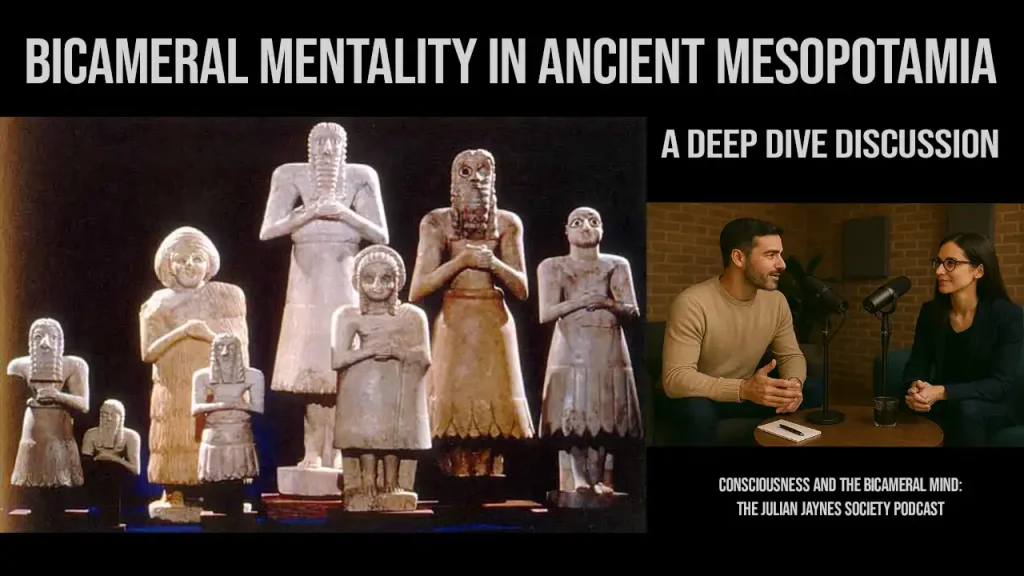
Bicameral Mentality in Ancient Mesopotamia: A Deep Dive Discussion
Welcome to Consciousness and the Bicameral Mind, the Julian Jaynes Society Podcast.
Learn more about Julian Jaynes’ theory or become a member by visiting the Julian Jaynes Society at www.julianjaynes.org
Bicameral Mentality in Ancient Mesopotamia: A Deep Dive Discussion.
Welcome to another deep dive where we plunge into ideas that fundamentally reshape our understanding of the human experience.
It’s great to be back.
Today we’re not just dissecting ancient history, we’re really embarking on an extraordinary intellectual journey, you know, excavating the very fabric of human mentality itself. Our lens for this profound exploration is the groundbreaking, and frankly, revolutionary theory of Julian Jaynes.
Absolutely. A game-changer.
And we’re setting our sights on one of history’s most enigmatic and foundational periods, ancient Mesopotamia.
A perfect place to start applying Jaynes’s ideas, really.
Exactly. So our mission, should you choose to accept it, is to meticulously unpack the bold claims and the compelling evidence that suggests the people of ancient Mesopotamia operated under a psychological framework radically different from our own. A mind profoundly influenced by what Jaynes’s called the bicameral mind.
Indeed.
And for those of you who have joined us before on these intellectual expeditions, you’ll know the revolutionary impact of Jaynes’s work. It just changes how you see everything.
It really does.
By deeply grasping the implications of the bicameral mind, we unlock, well, an unparalleled perspective on the intricate societal structures, the deeply embedded religious practices and the everyday lives of these earliest civilizations.
And it fundamentally challenges our ingrained modern assumptions, doesn’t it, about consciousness, about human nature itself?
Completely. This specific deep dive will not only demonstrate how Jaynes’s theory offers perhaps the most compelling and coherent explanation for the stark differences we observe between Mesopotamian societies and our modern introspective way of being. Right. But it also provides a framework that frankly, you just don’t get from conventional approaches.
Yeah, it fills in so many gaps.
Exactly. And since you, our astute listener, are already well-versed in the foundational tenets of Jaynes’s theory, we know you are, we can immediately immerse ourselves in its specific and fascinating application to Mesopotamia.
Right. No need for the 101 introduction.
No, we can delve directly into the profound nuances right away.
OK, so if we’re ready to dive in, let’s begin with Jaynes’s specific claims regarding Mesopotamia. He lays this out meticulously in his foundational work, particularly within his pivotal chapter, “A Change of Mind in Mesopotamia.” What is his central, dare I say, breathtaking assertion about the ancient Mesopotamian mind?
Well, Jaynes’s core assertion for Mesopotamia is truly audacious. It’s the bedrock of our understanding here. He posits that prior to the emergence of what we now recognize as subjective consciousness.
That inner voice, that feeling of me.
Precisely. That introspectable mind space where an analog ‘I’ constantly narrates and deliberates. Before that existed, non-habitual human behavior in civilizations like Mesopotamia was not driven by internal thought or planning or self-reflection as we know it.
So how was it driven? Instead, was profoundly and consistently guided by powerful auditory hallucinations.
Hallucinations, that sounds dramatic.
It does, but this is the critical distinction. These weren’t vague imaginings or, you know, metaphorical voices like we might say, my conscience told me. No, they were perceived as distinct, external, and absolutely authoritative commands.
External, like someone else speaking to you.
Exactly. Imagine, if you will, a world where the most crucial decisions, the spontaneous reactions, the very actions that steer daily life, were not the result of personal introspection, but direct imperative commands.
Wow.
And these commands were perceived as originating from their powerful earthly leaders, their revered ancestors, or most profoundly, from the gods themselves.
That implies a cognitive shift so radical it’s almost, well, it’s hard to wrap your head around it today.
It truly is almost unimaginable for us.
It’s a challenging idea for a modern mind to grasp sophisticated thought and action without that inner conscious monologue we just take for granted. Critics might say, isn’t that just a convenient explanation for what we don’t understand? What’s Jaynes’s strongest argument for how problem solving and reasoning would actually work in that state?
That’s a crucial and very fair question. And it’s a common misconception that this pre-conscious state implies, you know, a zombie-like or unintelligent existence.
Right, like automatons just following orders.
Yeah. And Jaynes decisively refutes this. He clearly posits that these ancient Mesopotamians were, in fact, highly intelligent. They were perfectly capable of intricate social organization, possessed sophisticated basic language, and were fully adept at learning, solving, complex problems, and adapting to their environment.
So they weren’t simpletons. The intelligence was there. Absolutely. The key missing element, as Jaynes meticulously defined it, was that specific capacity for introspection, that internal narrative ‘I’ operating within a mental space, that feeling of self observing its own thoughts. That’s what was different.
OK.
And Jaynes provides compelling modern analogies to illustrate how complex cognitive processes can occur without subjective consciousness. Think of a scientist or really anyone who, after grappling with a difficult problem, suddenly arrives at a solution in a flash of insight, that aha moment.
Yeah, it just pops into your head.
Right. Without consciously working through every single logical step, the solution simply arrives. Or, think about the effortless process of speaking and understanding speech right now. Words simply come to you.
You don’t consciously build the sentences word by word.
Exactly. You don’t introspect on their formation, their grammatical structure, or how you string them together. Your brain handles that automatically, unconsciously. These examples demonstrate sophisticated, yet fundamentally unconscious modes of mental operation that don’t require introspection.
Okay, so that explains how complex thought could happen without our kind of consciousness. How does that connect back to the voices?
Well, applying this to the divine voices, Jaynes asserts there’s no reason not to suppose that such voices could think and solve problems, albeit of course unconsciously.
Ah, so the voices themselves were doing the thinking.
In a manner of speaking, yes. These auditory hallucinations were far from static, pre-recorded commands. While they might have initially begun as, say, echoes of a king’s or chieftain’s directives.
Right, internalized authority figures.
Yes, but Jaynes argues that with time, especially as societies grew and challenges became more complex, these voices could actually improvise and say things that the king himself had never said. They became dynamic, problem-solving entities in their own right.
So the voices weren’t merely echoes of past commands. They were dynamic, problem-solving entities that could literally improvise novel solutions in real time. That truly shifts our understanding of their mental landscape. It completely changes the picture. Could you paint a vivid picture of what this might have looked like in daily life? How would that actually function for, say, a regular person?
Certainly. Let’s try. Imagine for a moment an ordinary worker in ancient Mesopotamia. Maybe a farmer is confronted with an unexpected drought, right? And needs to devise a new irrigation strategy.
OK. Instead of sitting down and planning it out?
Exactly. Instead of internal deliberation or conscious planning weighing options, they might experience a sudden, imperative auditory hallucination. The perceived voice of their city god, maybe Nungirsu or even their deceased grandfather, or a trusted leader.
Telling them what to do.
Directing their next action. Perhaps giving specific instructions on where to dig a new channel or suggesting what alternative crop to plant. It’s a direct external command solving the problem. Or consider a craftsman, a potter maybe, shaping a new clay vessel. Faced with a technical difficulty, a crack forming, they might hear a guiding voice from Ia, the god of crafts, providing a specific, previously unthought of solution to their problem.
Like a divine troubleshooting guide.
Pretty much. Even an individual embroiled in a complex dispute with a rival, maybe over land boundaries. Instead of lengthy argument or seeking mediation in our sense, they might experience a divine voice delivering a definitive judgment, perhaps from Shamash, the god of justice, which would then be accepted as authoritative by both parties.
Because it came from the god.
Precisely. This mechanism, this direct perceived divine guidance, wasn’t just for grand matters of state. It extended to everyday scenarios, ensuring the “continuity and utility to the group of his labors,” as Jaynes put it. It provided constant, immediate, and authoritative direction that fundamentally structured daily life and societal function.
It sounds like a pervasive, integrated system of governance, almost. Both external in society and internal in the mind, but perceived as external.
That’s a very good way to put it. External in its social manifestation, internal in its neurological origin. But crucially, perceived as external by the individual, all without that internal narrative space we associate with our own consciousness.
OK. Having explored the mechanisms of the bicameral mind and how it might have operated on an individual level, let’s now transition to its profound, tangible impact. How do these revolutionary ideas initially put forth by Jaynes find robust support and further elaboration in the work of later scholars? How have researchers like Marcel Kuijsten, how have he and Brian McVeigh added scientific and linguistic weight to Jaynes’s hypothesis specifically focusing on Mesopotamia?
That’s a vital connection to make because it shows this isn’t just Jaynes’s in isolation. It demonstrates the enduring and frankly growing strength of his theory. What’s truly compelling here is how Marcel Kuijsten in particular tackles what he calls the presentist fallacy.
The presentist fallacy. What’s that exactly?
It’s the common mistake, he argues, of interpreting ancient beliefs and experiences solely through our modern introspective mindset, applying our current understanding of consciousness and mentality back onto people who lived thousands of years ago.
Assuming they thought just like us, basically.
Exactly. In his essay, “The Gods of Mesopotamia and the Presentist Fallacy,” Kuijsten argues that this modern lens fundamentally misrepresents the direct sensory reality of divine auditory phenomena for the ancients. He contends that many mainstream scholars, maybe consciously or maybe unconsciously, dismiss the literal claims of ancient texts about hearing gods. They treat it as metaphor. Yes, as mere metaphor or poetic license, simply because such experiences are pathologized or seen as impossible in our current conscious era. I can’t imagine it was literal.
Okay, so Kuijsten says we need to take their words more literally. What evidence does he use?
Well, Kuijsten draws heavily on the work of Jean Bottéro, who is a renowned as Assyriologist. Bottéro extensively analyzed ancient Mesopotamian texts, their language.
What did Bottéro find in the language itself?
Bottéro’s linguistic insights reveal that the very language used in these ancient texts to describe interactions with the gods consistently points to a profound and literal experience of hearing, commanding voices.
Hearing them, literally.
Literally hearing them. This isn’t metaphorical language, according to Bottéro and Kuijsten. The vocabulary and grammatical structures they used convey a direct, undeniable auditory reception of divine directives. This phenomenon is entirely consistent with the bicameral mentality.
Can you give an example? Like, how did they phrase it?
For example, the terms they used for speaking with a god were likely closer in meaning to “hearing a god speak to me,” as if from an external, undeniable source. It wasn’t framed as engaging in an internal personal reflection or some kind of symbolic communication. The very structure of their language reflects a mental landscape where in an internal monologue, as we know it was absent, it was replaced by externalized divine commands that were simply heard. The language doesn’t support an interpretation of internal dialogue or metaphorical encounter.
That’s a crucial distinction. Moving from reading it as metaphor to understanding it as a description of a literal, phenomenal experience, it really makes you realize how much our modern bias affects historical interpretation.
It really does. We project our own minds backward.
Yeah. Now, what about Brian McVeigh’s contributions? How does his work in The Other Psychology of Julian Jaynes add to our understanding, particularly from, a neurological and cultural perspective? McVeigh delves into the brain’s functional organization in a potential bicameral state, offering a neurological framework that really complements Jaynes’ historical observations. He explains that the right hemisphere, which Jaynes posited as the primary source for these ancient auditory hallucinations.
The god’s side of the brain, so to speak.
You could put it that way, yeah. McVeigh suggests it worked in profound conjunction with the left, linguistically dominant hemisphere. Now, while the left hemisphere became the votally expressive spokesperson “self,” which in our modern consciousness is often taught to believe it’s unilaterally in charge of our thoughts and actions.
The narrator in our heads.
Exactly. McVeigh emphasizes that perceptual cognitive inputs from both hemispheres genuinely constituted part of the same self. It wasn’t about two separate competing brains, but a unified self experiencing commands that, while originating internally, were perceived as external.
Okay, so it challenges our modern idea of a single left brain dominated self. It really does. It suggests a historical period where the hemispheres operated with a more fluid, integrated, yet externally oriented interaction where the right hemisphere could effectively speak to the left hemisphere, delivering those commands.
And McVeigh also talks about culture, right? How culture shapes how we interpret experiences.
Yes, and this is another crucial point he makes. Cultural traditions play a profound role in shaping the definition of what constitutes a hallucination or an anomalous experience. In what McVeigh refers to as “less rational cultures,” meaning less dominated by modern Western rationalism, the distinction between reality and fantasy was far more flexible.
Things weren’t so rigidly separated. Precisely. Individuals in these societies were socialized, essentially trained from childhood, to readily accept their own imagination, which in a bicameral context would manifest as hallucinatory voices, as legitimate external realities, not as internal fantasies.
Unless we’re taught the opposite.
Exactly. This contrasts starkly with rational Western societies where such experiences are typically pathologized, seen as signs of mental illness. McVeigh suggests this leads to an unfamiliarity, even a distrust, of one’s own imagination in our culture.
So this cultural framework helps explain how hearing voices could be normal in Mesopotamia.
Absolutely. It provides a powerful lens through which to understand how the bicameral mind could function as a normative, integrated aspect of daily life. Hearing divine voices wouldn’t have been seen as pathology, it would likely have been seen as a sign of divine favor, a blessing, or simply a necessary guide for living. It was part of the accepted reality.
This cultural framing is so important, it makes you wonder then, doesn’t it, if these latent neural mechanisms exist in us, how much of our own inner voice might be a highly domesticated, interiorized echo of what was once an external command?
That’s a fascinating thought, isn’t it? The vestige of bicameralism.
And this isn’t just theoretical speculation, is it? There’s actual modern empirical data that provides compelling scientific validation for Jaynes’s neurological model.
Absolutely. And this is where Jaynes’s theory moves from being a brilliant historical hypothesis to something with, well, firm contemporary scientific grounding. Let’s consider modern manifestations of command hallucinations. Well, a significant range, studies show, between 18 % and 89 % of psychiatric patients report hearing command voices.
Which is already quite high.
It is. But what’s perhaps even more striking is a large-scale study cited in Conversations on Consciousness [and the Bicameral Mind]. They looked at over 10,000 people from the general population.
Not psychiatric patients.
No, the general population. And they found that a remarkable 8.3 % reported hearing a command voice at least once in their lifetime.
8%! That’s a lot of people.
It’s a truly compelling figure. It suggests the neurological hardware for these divine voices isn’t some ancient anomaly that disappeared. It seems to be a latent capacity still present in our brains, a potential biological echo of bicameralism. Jaynes himself, in his own earlier studies, found that about half of the women students at a religious college reported having hallucinated playmates in childhood. And some of those still experienced clearly heard voices in times of stress without being psychotic.
So not linked to illness necessarily.
Not necessarily, no. This strongly supports the idea that the neural mechanism for producing such voices is inherent in our brains, a vestigial capacity that can, under certain conditions, like stress, maybe illness, maybe drugs, be reactivated.
OK, that’s the prevalence. What about the specific brain mechanisms Jaynes proposed, the right hemisphere link?
Right. And perhaps the most crucial piece of empirical data for Jaynes’s theory lies in the scientific validation of his neurological model, what he called his fourth hypothesis. In the decades since the publication of The Origin of Consciousness.
His main book.
Yes. This hypothesis has in fact reached general scientific acceptance within relevant fields like neuropsychiatry, more than a decade of brain imaging studies, PET scans, fMRI…
The modern tools he didn’t have.
Exactly. These tools have consistently confirmed that auditory hallucinations often originate in, or show heightened activity in, the right temporal lobe, or related areas in the right hemisphere.
Just where Jaynes predicted.
Pretty much. Studies consistently show higher glucose uptake, which indicates increased neural activity in the right temporal lobe of patients while they’re actively hallucinating. While, the full picture is likely more complex, involving networks.
It’s never just one spot.
Of course. But several major studies concur with the general conclusion of right hemisphere overactivation of function or a left hemisphere deficit in these instances, particularly in conditions like schizophrenia where these voices are prominent. This directly supports Jaynes’s claim of a right hemisphere locus for these perceived voices, the very brain region that Jaynes proposed was responsible for the voice of the god.
That’s powerful validation. What about other lines of neurological evidence?
Well, think about hemispherectomy patients. People who’ve had one half of their brain removed. Yes, often due to severe epilepsy, particularly in very young children. What’s remarkable is how well the remaining hemisphere adapts. It can often take on much of the function of the missing half.
So one hemisphere can do the work of two to some extent.
To a surprising extent, yes. This provides compelling evidence for the brain’s plasticity and its capacity for more independent hemispheric operation than we might assume based on the modern integrated brain. It suggests that prior to the breakdown of bicameralism, the two hemispheres could have indeed operated with more distinct yet integrated functionalities.
Just as Jaynes proposed.
Precisely as Jaynes proposed for the communication of divine voices from one hemisphere to the other, it really validates the neurological plausibility of his model. It’s not just history or linguistics. There’s a solid neurological basis emerging. This incredible synthesis of ancient texts, modern psychological insights, and cutting-edge neuroscience really begins to paint a vivid, almost startling picture. It’s hard to overstate the implications.
It really is.
So let’s shift our focus now to the lived experience of the bicameral mind in ancient Mesopotamia. Moving beyond the abstract neural models, how did this profound psychological state truly shape daily life, their social structures, their religious practices? What did it mean for a civilization to have gods as active, ever-present participants in society, not just abstract concepts or symbols way up in the sky?
That’s where the theory truly brings ancient Mesopotamia to life. In a way nothing else does. What’s profoundly striking here and supported by a lot of historical work is that in Mesopotamia, the gods were not merely worshiped as distant celestial beings.
They weren’t just up there.
No, they were considered the literal active owners of the land and all its resources. This fundamental concept is strongly supported by scholars like Thorkild Jacobsen and Henri Frankfurt.
The gods owned the real estate, basically.
Essentially, yes. And the human king in this divinely ordered political system was not an autonomous sovereign in our modern sense, making his own decisions based on individual will or political calculation.
He wasn’t the ultimate boss.
No. Instead, he was explicitly a steward, a shepherd, or maybe a manager, directly accountable to the city god or the whole pantheon. His authority flowed entirely from divine mandate. He was executing divine will, not his own.
So the king’s power was entirely derived from and constantly dictated by the gods. It almost sounds like a direct chain of command, like a celestial hierarchy mirrored perfectly on Earth.
That’s a very apt description. A direct chain of command. And we see this demonstrated explicitly in their texts.
Could you give us some specific examples of how this divine mandate for kingship was actually demonstrated? How did they talk about it?
Absolutely. Consider the Enūma Eliš, the Babylonian creation epic. It vividly illustrates this principle. Marduk is appointed as the champion of the gods against the chaos monster Tiamat.
Right, the big showdown.
Yes, but he only accepts the job on the explicit condition that he be made first among the gods and crucially that his word shall have the force of the decree of Anu. Anu being the supreme sky god, the ultimate authority.
So he gets ultimate authority delegated to him.
Exactly. He’s invested with the powers and insignia of kingship by the assembled gods, not by human consensus or military conquest alone. And the decree states that his orders shall not be altered, his word shall not prove vain, and among the gods none shall encroach upon their rights.
Wow. So that sets the template for human kingship too.
Precisely. This narrative establishes a political order that was fundamentally and primordially divinely ordained, not humanly instituted. It reflects a society where all legitimate authority flowed directly from the divine. And this stands in stark contrast to later political systems like the Hebrew monarchy, for instance, which, as Frankfurt points out, was introduced on their own initiative in response to a crisis rather than being seen as part of the original divine creation order.
That’s a really key difference.
It is. And the depth of this belief, this direct connection is further exemplified in royal prayers and inscriptions. Foster’s anthology, for instance, includes a prayer by Nebuchadnezzar to Marduk.
The famous Babylonian king.
Yes.
And he praises Marduk’s wisdom, his power, his great destiny, and explicitly acknowledges that Marduk reveals to future peoples how to watch for his sign.
So the god is actively communicating, revealing things?
Actively involved, yes. This isn’t just flowery piety. It underscores the direct ongoing involvement of the divine in royal authority and the unfolding of future events. The king is actively seeking and presumably receiving direct guidance and legitimation from his god. The king was a vessel, an agent of the divine will, needing that constant connection.
That makes the gods incredibly tangible, doesn’t it? Not just abstract figures in some theology book. They were the ultimate authority actively shaping history through their human agents.
Right. They were participants. And this tangibility extended even to how they viewed idols, didn’t it? I mean, many modern people might see idols as mere symbols, representations. But for Mesopotamians, it seems it was far more profound.
Oh, it was profoundly different. And understanding this is absolutely crucial to grasping their mentality. Mesopotamians did not merely see idols as symbols. They were considered the literal living presence of the gods.
The god was the statue.
In a very real sense, yes. This is vividly demonstrated by the incredibly complex ritual called the “washing of the mouth,” the mîs-pî, which Hooke describes meticulously based on recovered texts.
Washing the mouth, what did that involve?
It was an elaborate multi-stage ceremony performed to ritually animate cult statues. The purpose was to transform them from inert objects crafted by human hands into the living embodiment of the deity. It wasn’t seen as a metaphor. It was a perceived literal transformation. The god was induced to inhabit the statue.
How did they do that? What did the ritual actually look like?
The rituals involved intricate steps and very specific, often precious materials. Special woods like Burkina wood and tamarisk, sacred water, water of the pots for holy water, precious stones like Sam 2, lapis lazuli, silver quartz, gold quartz, along with various offerings, incense like turpentine, oils like oil of millet.
So very specific ingredients for this transformation.
Very specific. These weren’t just symbolic gestures. They were believed to be material components directly involved in bringing the divine essence into the statue, allowing the god to open its mouth to see, to hear, to become present and active within the idol.
And there are prayers involved too.
Oh yes, powerful incantations. Things like “Tamarisk, Holy Tree, Thou Who Art Born in Heaven from its Wind, Juice of the Twig for that god, invoking the great gods Ea, Shamash, and Marduk,” and explicitly stating, “Holy Image that art perfected by a great ritual.” These were recited to literally imbue the statue with divine essence.
And what did the priest do?
The deacon, the Mashmashu priest, would stand to the left of the statue, performing actions like smearing the side of the statue with consecrated substances, whispering prayers directly to it. Imagine the sensory experience for a Mesopotamian observing this. The specific smells of the incense and oils, the rhythmic chanting of incantations, the careful handling of precious materials, all contributing to the overwhelming sense that a divine presence was truly descending into this physical form.
It sounds incredibly intense.
It must have been. And significantly, the texts show the involvement of all those craftsmen who have been in contact with the god, the sculptors, the goldsmiths. Their participation illustrates a communal, literal acknowledgement of the idol’s transformation into the god’s living presence. This was not abstract worship. It was a direct, palpable encounter with a perceived living god, a physical interface for the divine voice and will.
And this divine presence wasn’t confined to grand temples and these major royal rituals, was it? Did it reach down into ordinary homes?
Precisely. It permeated every level of society. The concept of individual or household gods was widespread and deeply integrated into daily life. These weren’t necessarily the great gods of the pantheon, but lesser, more personal deities, or perhaps divine ancestors.
Like a personal guardian angel, almost.
Sort of, but more actively commanding, perhaps. These personal deities would have been the direct sources of guiding voices for everyday actions within the family unit. Imagine a farmer needing to decide when to plant their next crop, or a potter facing a technical challenge, or a mother trying to resolve a conflict between her children.
They’d hear their household god.
Their personal god might deliver a direct auditory command or suggestion, guiding their mundane and significant decisions. This further illustrates the pervasive nature of bicameral guidance, extending beyond the public cults and the grand pronouncements of kings to influence every aspect of daily life, cementing the constant tangible presence of the divine throughout ancient Mesopotamia. It provided a continuous source of externalized moral and practical guidance for everyone.
This shifts our perspective dramatically. So if the gods were such tangible, active participants, literally owning the land and living in their idols, how did the bicameral mentality manifest in the practical mechanisms of Mesopotamian decision-making and their direct interaction with this divine realm? How fundamentally different was this from how modern societies seek guidance or make decisions?
The pervasiveness and the sheer directness of this communication are truly astonishing when viewed through our modern lens. Let’s revisit the role of the king, for example, as a primary recipient of divine commands.
Right, the steward.
Exactly. Jacobson notes that Enlil, known as Kugal, the great mountain, wasn’t just the abstract ruler of the universe whose word and command were unalterable. He was also seen as directly responsible for tangible natural phenomena like storms and hurricanes. His decisions, like those related to the devastating flood narrative where he was enraged at the escape of some of mankind and sought to wipe them out, these were seen as absolute, revealing the literal force of his divine will shaping the physical world.
The gods weren’t just making suggestions.
Definitely not. And as I mentioned, Marduk’s kingship was conferred by the assembly of the gods, granting him ultimate authority and power, which the human king then embodied and enacted. It was a direct mirroring of divine authority on earth, where the human ruler served as the physical manifestation and mouthpiece of the divine will.
OK. And how did this manifestation extend to prophecy? Was it like modern prophecy, sort of predicting the future vaguely, or something far more direct and integrated into daily governance?
Oh, it was profoundly different from our modern, often vague understanding of prophecy. Citing the work of Martti Nissinen and who study neo-Assyrian prophecy extensively.
Okay.
He found that prophetic oracles were meticulously preserved in state archives and critically they were explicitly composed as direct divine speech, literally quoting the god mediated by a named prophet to an individual, usually the king or sometimes a larger audience.
So not an interpretation of signs.
No, not primarily, that was divination which we’ll get to. This was different. These prophecies were not outcomes of analyzing omens or probabilities. They were presented as pure, unadulterated divine utterance, direct commands or statements from the god.
Wow. Do we have specific examples of this?
Yes, compelling ones. Esarhaddon’s inscriptions, for example, often refer to and clearly presuppose widespread knowledge of specific prophetic oracles. He even seems to have used them as sources for his historical narratives, suggesting that prophecies directly dictated or confirmed historical events.
Like citing a divine press release
Almost. For instance, Nissinen details how Esarhaddon’s account of his rise to power, his struggles with his brothers, could be followed almost step by step with collected oracles that legitimized his claim, confirming their direct impact on politics.
That’s incredible. Any other examples?
A prime one is a letter found in the archives from a priest named Ashur-Matua to King Ashurbanipal, around 668 BCE. This unique text explicitly begins with a prophetic oracle where the god Marduk himself declares, quote, “I have entered the city of Babylon and made peace with the goddess Mullissu, and through her with Ashurbanipal.”
The god is speaking directly in the letter.
Directly quoted. The letter then provides notes about its dispatch, showing how direct divine commands, received through prophecy, were integrated into immediate political action and diplomatic maneuvers. This isn’t interpretation, it’s an imperative, a direct divine intervention shaping state affairs recorded and acted upon.
And you mentioned this differs from, say, biblical prophecy. Yes. There’s an interesting contrast. Unlike the Hebrew Bible, which often describes major conflicts between prophets and the established institutions with prophets challenging kings and priests.
Right. The outsider challenging power.
Exactly. Mesopotamian uniformed sources, however, largely present prophets as integrated within and supporting the institutional order. They shared these symbolic worlds, as Nissinen puts it, of both the temple communities and the royal court. They largely seemed to support the institutional order, indicating a generally consistent, harmonious reception of divine guidance, a seamless flow of commands from the gods through the prophets to the ruling elite.
That’s a powerful distinction, suggesting a society far more tightly integrated with its perceived divine guidance. What about dreams? We often think of dreams today as, you know, subconscious expressions, maybe symbolic messages from ourselves. But in ancient Mesopotamia, were they seen differently?
Oh, absolutely differently. The role of dreams was absolutely critical, and they were seen as serving as a direct and authoritative conduit for divine messages, not as subconscious ramblings in our modern psychological sense.
So messages from the gods, not from the self.
Precisely. William Harris points out that in classical antiquity, and this certainly applies to the broader ancient world, including Mesopotamia dreams, were frequently described as epiphanies.
Epiphanies, like a sudden realization.
More like a direct appearance. Often, a single dominant authoritative figure — a god, an ancestor, a messenger — appears in the dream and conveys explicit instructions or information. This wasn’t just a literary trope. Harris argues it was a powerful and deeply ingrained cultural convention serving practical needs like legitimizing actions — “the god told me in a dream” — claiming superior knowledge or conferring prestige. It reflected a world where gods and other superhuman figures sometimes took an interest in the affairs of individual humans, and dreams were a primary way they communicated.
Okay, so dreams were taken very seriously as communication. Do we see this in their famous stories?
Absolutely. The Epic of Gilgamesh, a quintessential Mesopotamian text, provides prime examples. Gilgamesh’s terrifying dreams before meeting Enkidu.
Yeah, I remember those. Very vivid.
Exactly. They were interpreted by his mother, Nissinen, not as psychological anxieties, but as direct warnings of disaster, or more accurately, as literal predictions of future events. His first dream of a meteor falling from the sky, which he can’t lift. While later analysis might call it symbolic, it was understood by him and his mother as a real, phenomenal message predicting the arrival of Enkidu, someone equally powerful whom Gilgamesh would initially struggle with, but ultimately befriend.
So the interpretation was about the event, not the symbol itself.
Largely, yes. The fact that the interpretation in the text sometimes deviates from the customary style of strict one-to-one symbolism, as Oppenheim notes, actually highlights the direct non-symbolic nature of the divine communication within the dream itself. His mother’s interpretation was about recognizing the divine message embedded in the experience, not analyzing a subconscious symbol set. The message was the reality presented in the dream.
And they had rituals around dreams too.
Oh yes. We know from texts studied by Oppenheim about things like magically provoked dreams, rituals to induce a divine message through a dream, and also elaborate rituals for mitigating the evil consequences of bad dreams.
Like warding off a bad omen.
Exactly. These involved symbolic acts, like burning something representative of the dream, touching the floor upon waking, whispering specific prayers to appease a personal god. This underscores the literal, powerful impact attributed to dreams as direct divine interventions, requiring tangible ritual responses. They weren’t just dismissing them as just a dream.
It seems even later, more rational thinkers sometimes believe this.
Indeed. Even Galen, the famous Roman physician in the second century CE, displayed a profound belief in the authenticity of some apparently divine dreams, especially those received in the healing sanctuaries of Asclepius. He was willing to put an almost unprecedented trust in the advice dreams gave about medical treatments based on patients’ reports or even his own dreams. This shows the long-lasting, widespread acceptance across the ancient world of dreams as a potential source of direct divine counsel, not just internal rumination. It was an external voice perceived within a dream state.
So whether awake through prophecy or asleep through dreams, the divine was always potentially communicating. Now, what about other forms of divination, like reading sheep entrails or observing oil on water? How does that fit into this bicameral framework, since it seems less like a direct voice?
That’s a good question. Divination practices such as extispicy, the analysis of entrails, particularly the liver, which Bottéro discusses, were certainly not abstract fortune telling in our modern carnival sense.
Right, not like reading tea leaves for fun.
No, no. They were another structured, highly complex methodology for receiving direct divine instruction or gaining insight into the explicit will of the gods, particularly when direct auditory voices might be less clear, absent, or perhaps needed confirmation.
So a way to access the divine message when it wasn’t being spoken directly.
Exactly. These were formalized processes, requiring highly trained specialists designed to hear, or perhaps better, to read the divine plan encoded in the physical world in the sacrifice. By meticulously examining the markings, the shape, the texture of the liver of a sacrificed animal, a priest believed they could read the intentions or commands of the gods regarding a military campaign, a building project, the king’s health, or even a personal decision.
So it was still about getting an external message from the god?
Precisely. It was another way the externalized divine agency manifested its will. It required skilled interpretation, yes, but the source of the message was still firmly believed to be the external god, not the priest’s own intuition. It pointed to an external divine will, not an internal human deliberation or probability calculation. It was just another channel for the commands.
This leads us naturally then to the grand physical expressions of this whole bicameral worldview. If the gods were literally present, communicating through voices, dreams, entrails, how did Mesopotamia’s monumental architecture and their elaborate public rituals serve as tangible interfaces with the divine? It seems like the physical environment itself was meticulously designed to facilitate and reinforce this bicameral experience, creating a kind of constantly reinforcing feedback loop between the people and their gods.
That’s a profound observation and it’s absolutely central to understanding their society. The connection between Mesopotamian material culture, their buildings, their art, and the bicameral mind is deep and pervasive. The ziggurats and temples, for instance, these iconic structures.
The huge stepped towers.
Yes. They were not just places of communal worship in our sense. They were conceived as cosmic mountains, replicas of the sacred mountain where heaven and earth met, and crucially, as the literal dwelling places of the gods on earth.
Or the god’s house.
Literally, the god’s house, the “É.” These massive structures functioned as direct points of contact, physical anchors, facilitating the perceived descent of the divine into the earthly realm and providing a place from which the god could issue commands. The temple embedded the deity’s presence directly within the urban landscape. It was the physical manifestation of the god’s power and presence, the source from which the voices would emanate or be most clearly heard.
So, they were built not just to honor the gods, but really to contain and facilitate direct interaction with their literal presence, like a vast divine communication hub.
That’s an excellent way to put it, a divine communication hub.
And think about the major festivals, like the New Year Festival, the Akitu Festival in Babylon, which Hooke describes based on ritual texts.
A really important event, right. Hugely important. This elaborate multi-day ritual was central to reaffirming divine authority and ensuring the cosmos’ order for the coming year. During this festival, Marduk’s cult statue, his living presence, was brought out, taken in procession, brought into the special “Piraku Shrine of Destinies,” where the fixing of destinies for the coming year was ritually enacted.
The gods decided what would happen.
Yes. And this ritual was the moment it happened, mediated by the king and priests in the presence of the god statue. This was a direct, communal experience designed to receive and reaffirm divine commands for the coming cycle. Imagine thousands of people gathered in Babylon, participating in these rites, hearing the incantations, witnessing the movements of the jewel-encrusted cult statue, all designed to collectively reaffirm the reality of the divine commands that would govern their lives for the next year.
It sounds like it would make the divine presence incredibly real and immediate for everyone.
Absolutely. And we have texts like “The Ritual Commentary,” VAT 9555, which explain every single detail of the New Year Festival ritual by reference to specific events in mythology, particularly the Enūma Eliš. This signifies a deep literal belief in the active presence and influence of the gods in earthly affairs and the cosmos. As the scholar, Mircea Eliade, observed for religious man, the festal calendar everywhere constitutes a periodical return to the same primordial situations and hence a reactualization of the same sacred time.
So the ritual wasn’t just commemorating the myth, it was making it happen again.
Exactly. This ritual reenactment was not symbolic in our sense. It was a perceived reactualization of the same mythical events, intended to directly transfigure his existence by aligning it with a divine model, and crucially, allowing new divine commands and destinies to be heard and established for the coming year. So the very landscape, the architecture, and even the annual calendar were meticulously designed to reinforce this direct continuous connection with the divine, making the bicameral experience not just internal but profoundly externalized and communal.
Absolutely. The sheer scale and design of these structures, like the towering ziggurats reaching towards the heavens, reinforced the overwhelming power and presence of the bicameral gods. They weren’t built out of human ambition alone, though that might have played a part, but fundamentally as direct responses to perceive divine commands — “build me a house” — or to properly house and honor the literal presence of the gods who spoke to them and ruled them.
And you mentioned this focus differs from, say, Egypt.
Yes, it’s a useful contrast. While Frankfurt discusses the immense pyramids in Egypt as being primarily linked to the dead king becoming the god Horus and ensuring his journey and power in the afterlife, focusing on the divine king.
Right, the focus is on the pharaoh.
Mesopotamian monumental architecture, primarily the ziggurats and temples, focus squarely on being direct interfaces with the living active deity who is considered the true ruler and owner of the land, the one issuing the commands. Any form of monumental architecture, even if not explicitly mortuary in the Egyptian sense, served to reinforce the overwhelming presence and power of these bicameral gods in the physical realm. It created a landscape that constantly reminded inhabitants of their divine rulers and the source of their societal order. These grand structures were literally places for the gods to reside and communicate from. They were broadcasting stations in a way.
This leads us to perhaps the most profound and frankly challenging part of this deep dive: trying to imagine the sheer pervasive reality of daily life for an individual in ancient Mesopotamia, constantly operating under the influence of the bicameral mind.
The hardest part to grasp, maybe.
How fundamentally different was their experience of self, of agency, of the world itself compared to our own introspective conscious existence? This is where the truly revolutionary impact of Jaynes’s theory becomes vividly clear, I think.
It is almost impossible for us to fully grasp, because it requires us to shed our most deeply ingrained assumptions about what it means to be a thinking, acting human being. Our whole sense of self is tied up in that inner voice.
Right. But let’s try. Let’s try to really reimagine daily routines through this bicameral lens.
OK. From a farmer planting crops to a craftsman at their workbench to a soldier preparing for battle, every non-habitual action, every decision beyond simple rote habit could potentially be initiated or guided by an explicit, perceived divine voice.
So not just big decisions, but everyday stuff too.
Potentially, yes. Especially when faced with novelty or stress. Consider a farmer again. Instead of consciously deciding which field to irrigate next based on soil conditions or past yields, he might hear the voice of the harvest god Ninurta, or maybe a local field deity directing him precisely where and how to dig a new channel, or when to plant a specific crop, perhaps even telling him which plot would yield the most this season.
Like getting farming advice directly from the source.
Exactly. Or a builder, faced with a complex structural problem in a wall, might hear the voice of the great god Enlil dictating the precise measurements or the specific method needed to ensure stability. No calculation, just command.
Wow. What about social interactions, like choosing a spouse?
That’s a fascinating area. Imagine a young person considering marriage. Rather than introspecting on their feelings or assessing personal compatibility or weighing family alliances in a conscious way, they might receive the direct command from a household god or perhaps the voice of a revered ancestor instructing them precisely whom to marry or perhaps even where to go to find a suitable partner chosen by the gods.
That takes arranged marriage to a whole new level.
Doesn’t it? Or think of an artist maybe carving a relief for a temple wall. They might perceive a divine instruction from the temple god for a specific motif, a particular stylistic element, or the exact placement of a figure.
Creativity by divine dictation.
Perhaps. Even a judge in a complex legal dispute. They wouldn’t rely solely on human precedent, or abstract principles of justice, or even personal judgment, but might actually hear a god’s voice Shamash, the sun god and god of justice, delivering the verdict directly. And that verdict would be seen as absolute, divinely ordained justice.
So this provided an externalized framework for everything. Decision making, responsibility, social order.
Yes, an externalized framework for decision making, for responsibility, and for social cohesion that is utterly alien to our introspective, volitional modern experience. It meant that upon ability and the very nature of action were fundamentally different. And action was not primarily my choice in the modern sense. It was often a divine command, which the individual simply executed. Responsibility lay in obedience.
So without that introspection, that inner space for self-reflection, what did that mean for concepts we hold so dear today, like subjective guilt or individual responsibility, or even things like personal ambition, or planning for the future?
The implications are profound, really. Without an analog ‘I’ narratizing in a mind-space, as Jaynes defines consciousness, concepts like subjective guilt, feeling bad inside about something you did, or individual moral deliberation, weighing right and wrong internally, these would be radically different, maybe even absent in the way we experience them.
How so?
Well, actions were simply performed because a god commanded them. If an action led to a negative outcome, a crop failure, a lost battle, it wasn’t necessarily a matter of internal guilt or a failure of personal will or planning in our sense. It might be seen as a failure to correctly hear the divine voice, or perhaps a temporary absence of that voice, or simply a harsh divine decree that had to be born. Agency, the source of action, was fundamentally externalized.
That helps explain a lot about their society, doesn’t it? The strict hierarchy, the emphasis on divine law.
It really does. It helps explain the strict hierarchical nature of Mesopotamian society and its overwhelming emphasis on divine law and omen interpretation, rather than individual conscience or abstract ethical reasoning. It was about conforming to the external divine order.
And this connects to that idea of the world being full of messages. Perfectly. It aligns perfectly with Mircea Eliade’s profound observation, that for religious man of the primitive and archaic societies, the world itself was literally fraught with messages. For Mesopotamians, the cosmos was a supreme creation of the gods, and it was constantly communicating.
Everything meant something.
Exactly. Messages might sometimes be in cipher, requiring a priest or diviner to decipher them through omens or rituals. But the myths, the stories of the gods, were there to help man decipher them. This implies a continuous lived interaction with a world that was always speaking, guiding, revealing the divine will, not an inert, meaningless environment that humans must passively observe or manipulate. Their very reality was a constant dialogue with the divine. Human experience was “homologized to cosmic life,” as Eliade put it, meaning it was perpetually intertwined with and sanctified by the divine order, revealed through these messages.
That truly makes so much more sense of their societal structure and their monumental achievements than just attributing it to, say, strong kings or efficient bureaucracy alone.
Absolutely. It wasn’t just about human leaders asserting power. It was perceived as a divinely ordained order, a consensus dictated by the gods themselves through these voices.
And that provided the social cohesion.
Precisely. The bicameral mind provided a unique and incredibly powerful social glue, with individuals and leaders alike hearing similar, reinforcing, and authoritative voices, whether attributed to kings, revered ancestors, or the gods themselves. A consensus-driven, strictly hierarchical society could function with remarkable stability and efficiency.
Less internal conflict, maybe.
Plausibly. This externalized control minimized internal dissent, individual questioning, the kind of subjective deliberation that can lead to paralysis or rebellion. It ensured collective action and obedience to a perceived divine order. And this goes a long way in explaining the monumental achievements. The ziggurats, the vast irrigation systems, the complex legal codes and the sheer longevity of these early civilizations. They were literally building and organizing society under perceived divine command.
But Jaynes didn’t think the system lasted forever, right? He saw it as inherently fragile.
Yes, that’s crucial. He recognized that this system, while incredibly effective for its time and circumstances, possessed inherent vulnerabilities. It wasn’t infinitely scalable or adaptable.
What made it fragile?
Well, as human populations grew, as societies became more complex, as trade routes expanded, and social connections diversified beyond the local city, state, or tribal group, the inflexibility of direct, unwavering divine commands faced mounting pressure. How does a voice tailored for a small group manage a sprawling empire with diverse needs?
Good point. And external factors.
Yes, Jaynes attributes the breakdown partly to increasing internal and external stressors. Major natural disasters like earthquakes, volcanic eruptions, devastating invasions from new peoples who perhaps didn’t share the same bicameral mentality.
And writing, you mentioned writing earlier.
Yes, and crucially, the widespread advent and use of writing. Writing facilitated the externalization and standardization of commands, laws, and knowledge. Divine pronouncements could be recorded, read, debated, compared.
Which reduces the need for the immediate internal voice.
Exactly.
It gradually reduced the reliance on internal auditory hallucinations for immediate guidance, and perhaps even began to create cognitive dissonance when written commands contradicted a perceived voice. These pressures, combined with the emergence of new technologies and more complex social structures, necessitated a more adaptive, more internally flexible mind. This paved the way, Jaynes argues, for the gradual, likely painful emergence of subjective consciousness, our introspective mind, which provided a more efficient means of navigating, planning, and coordinating within larger, more diverse populations in an increasingly complex and unpredictable world. It was, in essence, an evolutionary adaptation of the mind itself, driven by historical pressures.
And this brings our deep dive to its powerful crescendo, really. The profound shift from the bicameral to the conscious mind is arguably one of the most significant, if least recognized, transformations in human history.
It truly might be.
The revolutionary impact of Jaynes’s theory on our understanding of this transformation really does challenge deeply ingrained, often unquestioned assumptions about human nature itself. It makes you rethink everything.
It absolutely does. The breakdown of the bicameral mind in Mesopotamia and elsewhere wasn’t a sudden light switch flicking off. It was a gradual, probably tumultuous process, likely occurring over centuries, catalyzed by that confluence of factors we discussed. Population density, external stressors like migrations and conflicts, and the transformative power of writing.
Which allowed commands to exist outside the head?
Precisely. Recording divine pronouncements for all to see, allowing them to be preserved, compared, potentially questioned. This slow, likely-wrenching process led to the development of our modern, introspectable mind-space. That inner world where we narratize our experiences, conceptualize time spatially, looking back, planning ahead, and experience that distinct analog ‘I’ that feels like the stable center of our being. j
And just to circle back to the scientific validation of Jaynes’s work, you’ve mentioned the neurological model finding acceptance. How broadly should we view that acceptance, especially given how, well, radical the overall theory still feels to many?
It’s crucial to reemphasize this point because it’s a testament to Jaynes’ intellectual foresight and the sheer rigor of his multidisciplinary approach. His fourth hypothesis, the specific neurological model for the bicameral mind, involving the right hemisphere, that has indeed reached general scientific acceptance in the relevant fields in the decades since his book.
So the brain part holds up.
The core neurological mechanism he proposed holds up remarkably well. More than a decade of brain imaging studies, using PET, fMRI, and other techniques, have consistently provided compelling evidence supporting a right hemisphere locus, or at least significant involvement for auditory hallucinations.
The higher glucose uptake, the over-activation patterns.
Exactly. These studies consistently show that increased neural activity in the right temporal lobe, or related networks, correlates with the experience of hearing voices. This empirical data offers powerful, demonstrable validation for the brain’s inherent capacity to generate what were once perceived as external, divine voices.
And the hemispherectomy evidence adds to that plausibility. Yes. The evidence from hemispherectomy patients, showing the brain’s remarkable adaptability and capacity for more independent hemispheric function than we might assume, further supports the idea that Jaynes’s model of cross-hemispheric communication for bicameral voices is neurologically plausible for that earlier era. So it’s not just a historical or philosophical theory. It’s one with increasingly strong, verifiable, scientific backing for its proposed mechanism.
Which makes the whole project even more compelling.
It does. And what truly makes Jaynes’s project so intellectually bold and frankly fundamentally subversive is how it systematically contrasts with and directly challenges the prevailing mainstream paradigms in psychology, neuroscience, and anthropology.
The ones that assume consciousness was always there.
Exactly. Those paradigms typically assume, often implicitly, that consciousness as we know it is an innate, timeless, and universally present feature of the human mind. Just part of being human always has been.
But Jaynes flips that entirely.
He flips it entirely. His work forces us to confront the radical notion that subjective consciousness is in fact a learned, cultural construct, an elaborate mental metaphor built upon language, emerging relatively recently in human history. This profoundly alters our understanding of not only ancient peoples, like the Mesopotamians, but also the very nature of our own minds.
It suggests our consciousness isn’t fundamental, but learned.
A learned capability, yes.
It’s a project of immense, demonstrative ambition, as it’s been called, that courageously tackles the most fundamental questions about what it means to be human. It refuses to shy away from conclusions that overturn centuries of philosophical and scientific assumptions about the mind.
And it provides a coherent framework. That’s the key. Jaynes’s theory, supported by that rich tapestry of historical evidence, logical reasoning, and empirical data, both from sources he cited and extensive supporting evidence described by others since, makes it arguably one of the most comprehensive frameworks ever produced on this subject. It provides coherent explanations for a vast array of ancient phenomena, from divine kingship and oracle use to societal structure, dream interpretation, and architectural purpose phenomena that often remain deeply perplexing, or are explained away unsatisfactorily under conventional interpretations.
It connects the dots in a way other theories don’t seem to.
Exactly. Jaynes’s work provides tremendous insights that would otherwise be missed making this deep dive, we hope, a truly definitive exploration of its subject in the Mesopotamian context. It’s nothing less than a potential new psychology of human history, providing a framework for understanding phenomena that mainstream paradigms often struggle with, leaving them as inexplicable anomalies or cultural quirks.
This deep dive into ancient Mesopotamia through the revolutionary lens of the bicameral mind has been truly monumental, hasn’t it? It really reiterates the profound implications of considering a civilization where the very fabric of their reality was woven from perceived divine commands.
It changes everything when you look at it that way.
It leaves us with a truly thought-provoking idea, maybe for you listening to mull over. If they lived in a world literally fraught with messages, with actions constantly guided by externalized voices, how much of our own internal dialogue, our seemingly private thoughts and self-talk, might still carry faint echoes of those ancient externalized voices, perhaps in forms like conscience or intuition, that we are only just beginning to recognize or understand in our own subjective experience?
That’s a powerful question, and one that really encourages us to consider the astonishing plasticity of the human mind. Where did our inner voice come from? Understanding the historical shift from bicameral to conscious mentality compels us to consider not just what changed in the past, but perhaps what vast potential for different modes of human experience might still lie dormant within us. Or even how alternative forms of consciousness could yet evolve in the future.
The story might not be over.
It might not be. This deep dive into Mesopotamia is, of course, but one meticulously detailed piece of the larger intricate puzzle that Julian Jaynes unveiled. His theory touches on so many aspects of human history, psychology, and culture.
And we’ll definitely be exploring those in future Deep Dives.
Absolutely. So we strongly encourage you, the listener, to continue your own profound explorations into the broader implications of this extraordinary theory in other ancient contexts and even its relevance today. There’s so much more to unpack.
Well, thank you for joining us on the Deep Dive and for daring to explore these profound depths of human history and consciousness with us.