
Conversations on Consciousness and the Bicameral Mind: Interviews with Leading Thinkers on Julian Jaynes’s Theory
NOW 26% OFF ON AMAZON FOR A LIMITED TIME!
Did ancient humans experience consciousness differently than we do today?
What if the voices of gods once heard throughout the ancient world were not merely metaphors, myths, or religious inventions — but a fundamentally different form of human mentality?
In Conversations on Consciousness and the Bicameral Mind, leading scholars, psychologists, philosophers, anthropologists, voice-hearers, and consciousness researchers explore one of the most provocative and controversial theories ever proposed about the human mind: Julian Jaynes’s bicameral mind theory.
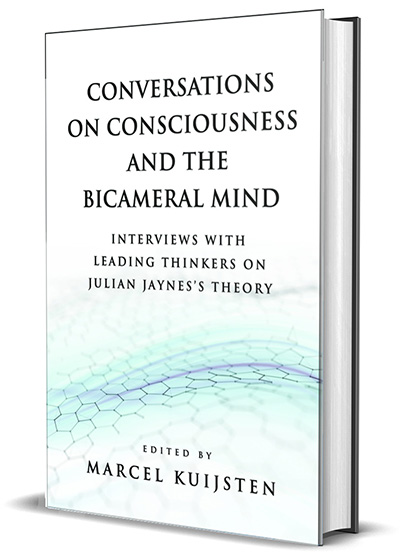
Originally introduced in The Origin of Consciousness in the Breakdown of the Bicameral Mind, Jaynes argued that human consciousness — introspective self-awareness as we experience it today — may not be an innate and timeless feature of the human species. Instead, he proposed that consciousness emerged culturally and historically, transforming human psychology, religion, language, and civilization itself.
This volume brings together an extraordinary series of interviews and discussions examining the implications of Jaynes’s ideas across disciplines including:
- consciousness studies
- psychology
- neuroscience
- psychiatry
- religion
- anthropology
- mythology
- history
- artificial intelligence
- voice-hearing research
The result is a fascinating exploration of some of humanity’s deepest questions:
- Could consciousness itself continue to evolve?
- What is consciousness?
- Where does the inner voice come from?
- Why do humans hear voices?
- Did ancient people experience the world differently?
- How are language, culture, and identity connected?
Rather than offering simple answers, this book invites readers into a rich interdisciplinary conversation about the origins of the self, the nature of human thought, and the strange history of the human mind.
Accessible to both newcomers and longtime readers of Jaynes, Conversations on Consciousness and the Bicameral Mind serves as an engaging gateway into one of the most ambitious theories ever proposed about human consciousness — and why it may matter now more than ever in the age of AI, social fragmentation, and rapidly changing human identity.
For readers interested in consciousness, philosophy, psychology, religion, neuroscience, cognitive science, mythology, or the future of the human mind, this book offers an unforgettable intellectual journey.
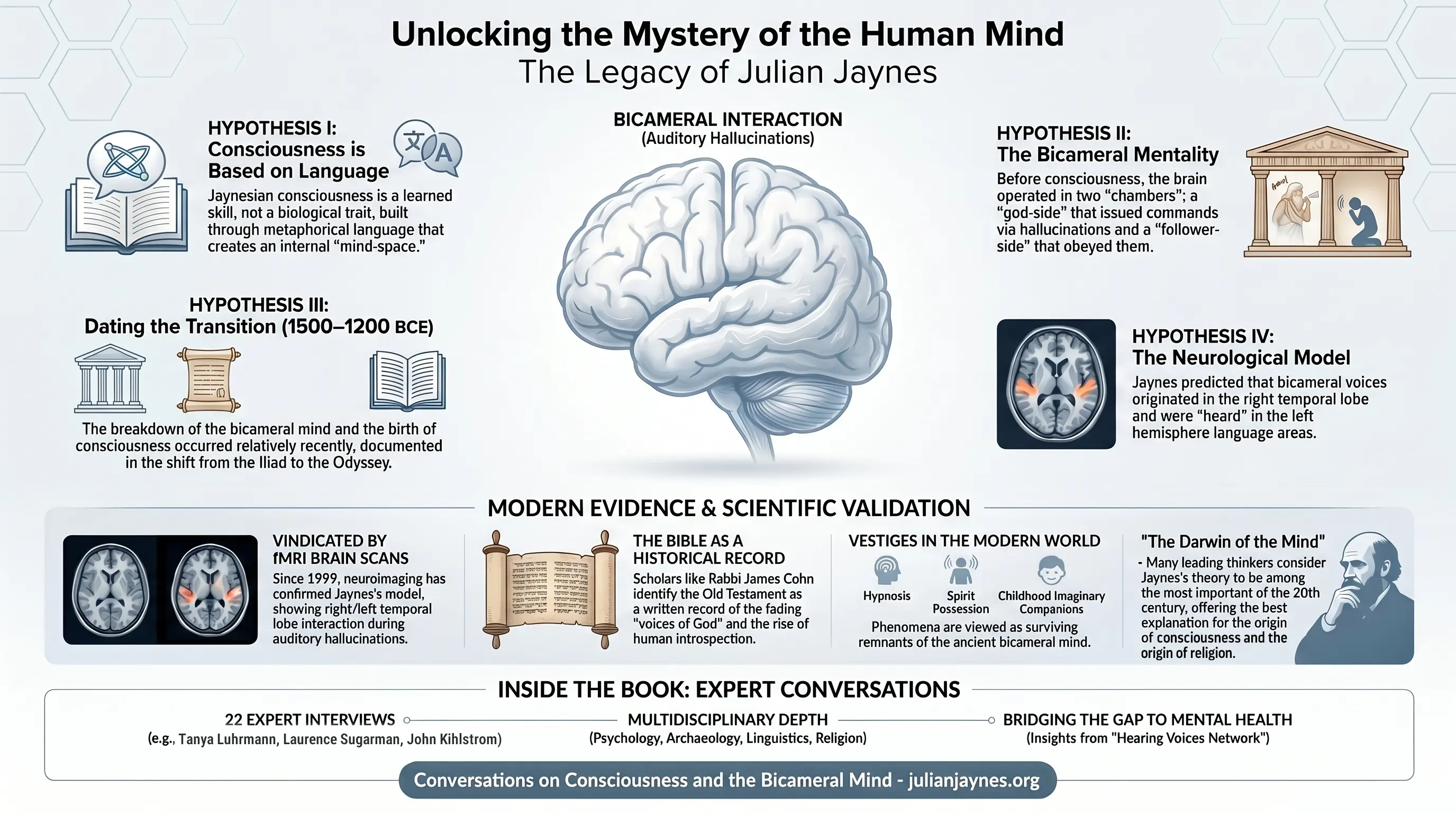
Conversations on Consciousness Infographic (click for larger version).
Praise for Conversations on Consciousness and the Bicameral Mind
“… A marvel of collective scholarship across multiple disciplines. … In this book, you will hear the voices of the most open-minded scholars of our generation.”
— William R. Woodward, Professor of Psychology, University of New Hampshire, and author of Hermann Lotze: An Intellectual Biography
“Rich with ideas and fertile speculations, this outstanding collection of expert interviews advances the revolutionary work of the psychologist Julian Jaynes.”
— Richard Rhodes, Historian and Pulitzer Prize Laureate for The Making of the Atomic Bomb
“Julian Jaynes was my teacher [at Princeton]. … Much psychological science since then points to the possibility that he was right. Right about consciousness, right about ancient history, right about evolution, right about language, even right about Homer. This volume begins to close the gap, bringing Jaynes’s brilliance to the attention and appreciation of the contemporary public.”
— Martin Seligman, Professor of Psychology, University of Pennsylvania, and author of The Hope Circuit and Learned Optimism
“I read Conversations on Consciousness and the Bicameral Mind … with great delight. … The material in Conversations is rich in detail and a great way to assist people to understand better each of [Jaynes’] core elements of theorising. The interviewers show great patience and a depth of understanding of the issues in play, and the interviewees demonstrate the abundance of research that has taken place over the last four decades that corroborate and refine Jaynes’ early insights. … We are greatly indebted to Julian Jaynes’ insights … and to Marcel Kuijsten for these interviews that demonstrate so well how alive, rich, and extensive is the field opened up by Jaynes.”
— Dr. Louis Arnoux, Managing Director, Fourth Transition Ltd.
“… It is time for a new generation of … deep thinkers at the heart of every discipline to rediscover Julian Jaynes’s tantalizing hypotheses concerning the origin and nature of human consciousness. This collection of interviews … will enable contemporary readers to understand why Jaynes’s style of inquiry remains as captivating and compelling as ever — and as provocative and controversial. Reader: take the plunge, and join the conversation!”
— Christian Y. Dupont, Ph.D., Associate University Librarian for Collections and Burns Librarian, Boston College, and author of Phenomenology in French Philosophy: Early Encounters
“… Conversations on Consciousness and the Bicameral Mind helps us understand humanity’s development of consciousness over millennia, as well as how we learn it in our first years of life.”
— Loretta Graziano Breuning, Ph.D., author of Habits of a Happy Brain, The Science of Positivity, and Status Games
Reader Reviews
I’m just about finished reading the interview with John F. Kihlstrom in Conversations on Consciousness and wanted to drop a few thoughts while it’s still sitting with me.
First off, I’ve got a lot of appreciation for what Marcel is doing here, and for everyone involved in this broader body of work. The interviews, the books, the lectures, the forum discussions, even the ongoing posts that keep everything connected, it’s a serious collective effort. The amount of work and consistency behind it is easy to underestimate, but it’s doing something quite important in terms of pushing the cutting edge of consciousness research.
What stands out most in Marcel’s contribution specifically is the way he handles depth. His interview style is genuinely engaging, but more than that, he clearly has a strong and detailed grasp of Jaynes’ work, the internal structure of it, especially the parts that tend to get challenged or misread. That comes through in how he responds to guests, when things get complicated or when there are real tensions in interpretation Marcel communicates with clarity and ease, and tends to resolve that tension without flattening it.
There’s also something interesting in how the conversations are shaped by that level of understanding. While the surface level ideas are presented early on, it is not long before they start to pull in the deeper material, the edge cases that most mainstream discussions either avoid or do not quite know what to do with. This is where Jaynes’ theory stands out, the integration of outliers like hypnosis, trance states, schizophrenia, Tourette’s, speaking in tongues, dreams, and the origins of religious experience. All of these start to feel less like separate topics and more like variations of a shared underlying structure of mind and language. For those willing to question the dominant paradigm, there is a profound expansion of context available here.
The Kihlstrom interview is a good example of Marcel’s interview dynamic. There is disagreement in places, acknowledged up front, but it never collapses into argument for its own sake. It stays open, both sides willing to sit with each other’s models, which is rare, but where the real value is.
The Sugarman interview was another standout. I ended up pausing Conversations on Consciousness after that one and going straight into Changing Minds with Clinical Hypnosis. That kind of ripple effect says a lot about the quality of the material and the kind of thinkers being brought into the series. I have also been using the footnotes and bibliography as a reading list.
Having read both of Marcel’s other edited books, it is safe to say this work represents some of the most up to date thinking on Jaynes’ theory. It does not invalidate the earlier work, it feels more like an ongoing expansion of it, extending into other fields. The theory is being actively stress tested against clinical insight, philosophy, and lived experience, and it holds up firmly.
There is a quote that keeps coming back to mind in the middle of all this:
“Words have meaning, not life or persons or the universe itself. Our search for certainty rests in our attempts at understanding the history of all individual selves and all civilizations. Beyond that, there is only awe.” — Julian Jaynes
That “only awe” part feels oddly accurate in this context. The more you sit with these conversations, the more it becomes clear that we are still very early in mapping what is going on with consciousness, especially when you bring in all the strange but persistent phenomena that do not fit neatly anywhere.
What keeps standing out is the idea that inner speech and layered internal “selves” form a structured system, and that a lot of what gets labelled as separate psychological symptoms may actually be different expressions of the same underlying architecture of identity and narration.
Anyway, all of this is to say I am genuinely grateful this work exists and is continuing to develop in public like this. It feels like one of the few areas where philosophy, psychology, and clinical insight are actually moving together rather than separately.
Armchair perspective, but it is hard not to be impressed by what is being built here.
— Chris W., Australia (Amazon.com.au)
This book has been endlessly fascinating, scintillating with insight and intelligence. As someone who has been ruminating on Jaynes for the past two decades it was surprisingly refreshing to find a collection of not essays, but a more easily digestible format — conversations — that clarify and expand upon this complex and often misunderstood/dismissed theory. Like a kaleidoscope, each chapter looks at the matters at hand through a different lens, with experts in different fields. For example, from a rhetorician’s perspective the creative potential of metaphor is highlighted, along with definitive insights about hallucination and ideology. Other outstanding chapters examine the vestiges of the bicameral mind through firsthand accounts of voice-hearers and TLE visionaries, all of them notably articulate. There are in-depth spelunks into the territories of child-development, imaginary friends, hypnosis, theory of mind, linguistics, psychology, history, Tibetan studies, religion, and philosophy. Kuijsten is a careful, diplomatic communicator who remains respectful and Socratic in debate, negotiating and adjusting perspectives wherever there are divergences in research or outlook. It is clear the intention here is an honest inquiry to further understanding, rather than a rigid imposition of ideas.
— Michael J., New York (Amazon.com)
Conversations on Consciousness and the Bicameral Mind – Product Flyer with Table of Contents
Conversations on Consciousness and the Bicameral Mind – Notes & Citations