
The Evolution of Early Board Games in the Light of Julian Jaynes’s Theory
by Ulrich Schädler
Board games apparently came up in the second half of the fourth millennium BCE. Although several stone boards with small holes found at various sites in Jordan and elsewhere and dating to Neolithic times (eight – seventh millennium BCE) have been interpreted as game boards,1 this view has been refuted with good arguments by several scholars.2 This is also the view of the author of these lines, as the reader will be able to understand once he has reached the end of this paper. A clay board with pieces associated with it from a predynastic grave in El-Mahasna in Egypt is often mentioned as the earliest example, but this interpretation has also been questioned.3 However, about 3000 BCE, board games are firmly attested in Ancient Egypt.4 Then, since the 3rd millennium, board games are also attested in Mesopotamia, ancient Persia, and the Indus Valley.
Until today, six different games have been identified in the archaeological record, attested by finds of game boards and pieces as well as representations in wall paintings, reliefs, on papyri and inscriptions. Egyptian board games are Mehen (mhn), Senet (zn.t), the “Game of 20 (squares)” and its double version, the ladder game (men), and the game of 58 holes, sometimes conventionally called “Hounds and Jackals” from an example in the Metropolitan Museum. Some of these games spread to other regions in the Near East including the Levant and Cyprus. The “game of 20 squares” seems to have originated in Mesopotamia, where several examples dating to the middle of the 3rd millennium BCE have been found in the Sumerian cemetery at Ur, of which the most famous is the one exposed in the British Museum.5 The game was also played in Persia, where a wooden board was excavated in Shahr-e Suḵhte6 and stone boards for the same game were found in Jiroft.7 From Jiroft and dating to the second half of the third millennium BCE comes another game, the name of which is unknown, with a board structured in three rows of twice six squares, similar to the much later Roman game boards for the “Ludus Duodecim Scriptorum” (the “game of 12 points”).8 There are game boards of other types preserved, with different arrangements and numbers of squares, but hardly anything can be said about these games.9
As far as we can tell from the archaeological record, all these early board games were “race games”.10 In this type of games, the players move pieces on a one-dimensional track in the attempt to reach a goal. All these early “race games” use random generators to move the pieces. The question we want to pursue in the following is whether this feature is in some way compatible with the Jaynesian theory? According to Jaynes’ theory, bicameral men, especially under stress, acted according to hallucinated commands or advice they perceived as external. Acting was thus motivated by commands interpreted as coming from a “chief, king, ancestors, or “the gods”,” (Kuijsten, Reflections, p. 101) and not the result of internal decision making (Jaynes, Origin, p. 72). According to Jaynes, consciousness as he understands it including the “analog I” projected into a “mind space” evolved from this bicameral state during the period we are dealing with in these lines.
Only since around 500 BCE games such as Polis in Greece and later Weiqi/Go in China came up, games of the type of “strategy games” or “war games”.11 For the first time, the pieces were no longer moved by an external device, but had an inherent potential to move and to exercise a certain power. This coincides rather well with the period in which the “subjective mind” with its “narratizing introspections” (Jaynes, Origin, p. 292) became established in ancient Greece. I am aware of the fact that these few sentences are a rather simplified and reduced summary of Jaynes’ concept. However, there seems to be an analogy between the behavior of bicameral men and pawns on the game boards of early civilisations. Both are guided by an external motor. Board games create situations in which both the players and the pieces on the board are under pressure — after all, a game is a competition. In such a duel, the players are constantly forced to make decisions, decisions that can quickly turn out to be wrong. Their pieces find themselves pursued by the opponent’s pieces and risk being blocked or captured. The players are therefore under stress, even if it is self-induced and voluntary. Could it be that for bicameral men it was just normal that a piece on the game board should need something to push it and should not have an inherent power to do so? Why did it take so long to develop pure strategy games? Are early board games a perfect picture of bicameral mentality?
Early Board Games in Mesopotamia, Egypt and Beyond
What do we know about these early board games? I will at first summarize especially aspects concerning the rules of the games, while for the moment I leave aside social, religious or (inter-)cultural aspects, which are less relevant for our discussion.
The earliest board game of which we have some information is the Egyptian game Mehen.12 Attested already at the end of the fourth millennium, it disappeared with the Old Kingdom c. 2200 BCE. The board shows a curled snake with the head in the center. As a matter of fact, Mehen means “the coiled one” and is the name of the curled snake-god. As gaming pieces, it seems that marbles on the one hand and figurines of crouching lions, lionesses and dogs were used, depicted on the wall-painting in the tomb of Hesy-Re (3rd dynasty, fig. 1).
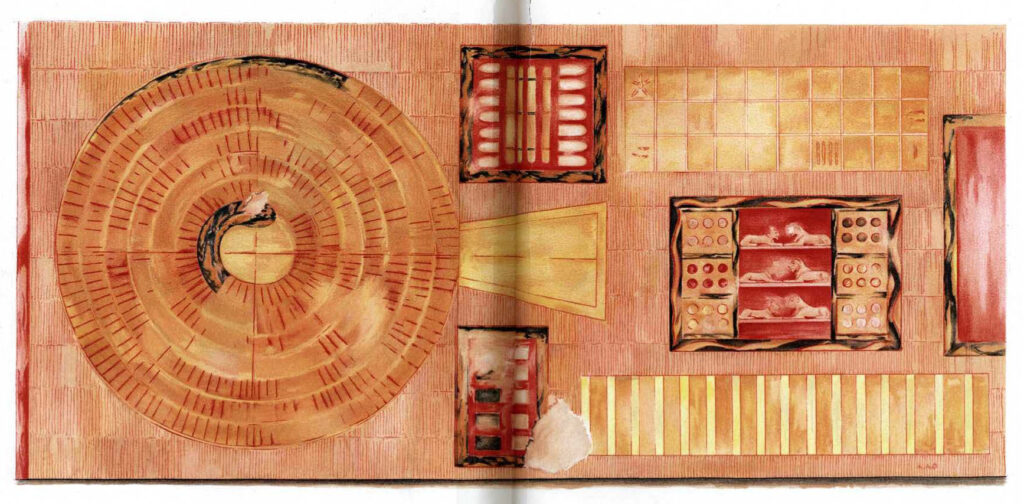
Figure 1. Mehen, Senet and the Ladder game, wall painting from the-Tomb of Hesy-re, Saqqara-Egypt, 27th century BCE. Drawing by James Edward Quibell 1913, pl. XI.
The fact that no evident random generators are depicted in association with the game board has led some authors to think that the game was not a race game. However, Edgar Pusch has argued that the marbles depicted together with the lion-pieces could have served to determine the moves of the pieces through a kind of “guess how many”-game, as is represented in later scenes.13 Moreover, in tomb n° 3504 from Saqqara (Early Dynastic Period, 1st Dynasty, shortly after 3000 BCE), several stick dice have been found together with material for this game, which indicates, together with its one-dimensional track, that the game indeed was a race game.14 As for the rules, attention has been drawn to the “Hyena game” attested from contemporary Sudan, which may give some better idea.15
Perhaps the best-known Egyptian board game is Senet, attested by numerous game boards and representations (fig. 2).16 The game often covers one side of a wooden game box, while the opposite side bears a “Game of 20 (squares)”, as for example one of the game boxes found in Tut-Ankh Amun’s tomb. The board consists of a track of 30 squares, arranged in three rows of 10 squares each in order to form an s-shaped track. Some of the squares, usually the last five, bear a hieroglyphic symbol. The game was played by two players using 7 or 5 counters each. The aim of the game seems to have been to move one’s counters along the track and off the board with the help of random generators such as stick dice.
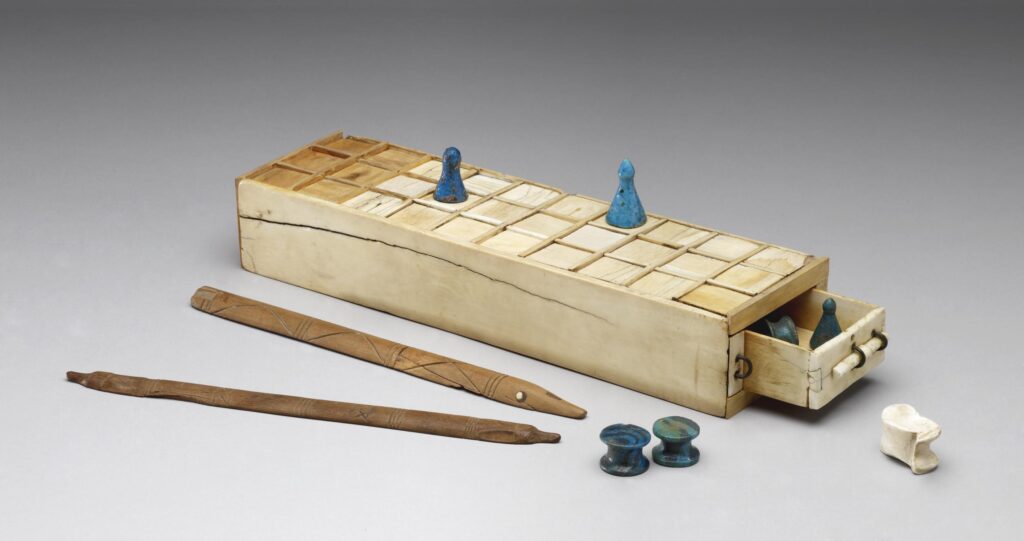
Figure 2. Ivory Game Box for “Senet” and “20 squares” with counters, two throw sticks and a knucklebone, Egypt, New Kingdom, c. 1400-1200 BCE. British Museum, London, inv.-n. 1886,1009.265 (© The Trustees of the British Museum, CC BY-NC-SA 4.0 license).
The “Game of 20 (squares)” is attested by over one hundred finds (fig. 3).17 It seems that it originated in Mesopotamia, where several boards and pieces have been discovered in the Royal tombs at Ur, dating to the middle of the 3rd millennium BCE.18
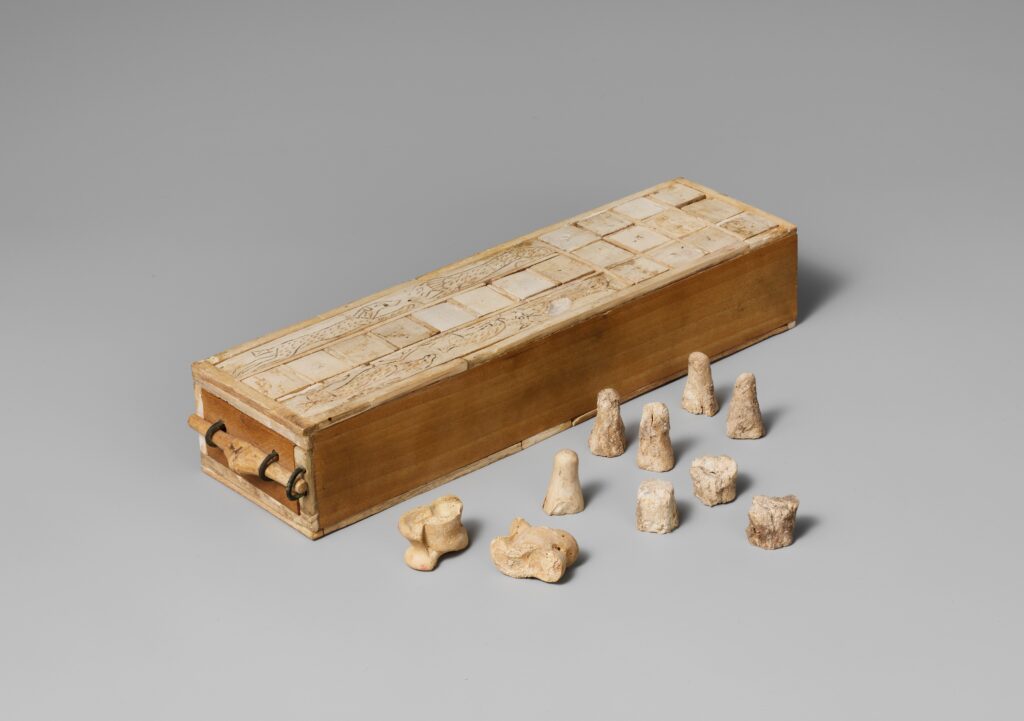
Figure 3. Game box for “20 Squares” and “Senet” with counters and knucklebones, from Thebes (Egypt), Asasif, Courtyard CC 41, Pit 3, Burial E 3, c. 1635–1458 BCE, Metropolitan Museum, New York, n. 16.10.475a (public domain).
From there, the game travelled to Egypt, where it is documented from the 17th dynasty down to the middle of the 20th dynasty. Here, the board took another form: it consists of a central row of 12 squares bordered at one end by four squares on either side. The earlier Near Eastern examples from Ur and Shahr-e Suḵhte are different: here the central row of 12 squares is bent at one end to form a head of 2 ✕ 3 squares. The direction of play is best illustrated by the stone boards from Jiroft (Iran) in the shape of eagles, scorpions and a scorpion-man (fig. 4).19 Here, the central row of squares runs through the body, while the four flanking squares cover the wings, claws and arms. It is therefore plausible to assume that both players entered their counters into these four starting squares on both sides and had to move them down the body along the central row.

Figure 4. Game board for “20 squares” in the shape of an eagle, from Jiroft, c.2500-2000 BCE. National Museum of Iran, Tehran (Wikimedia Commons).
On many boards, certain squares including the last are marked by rosettes or a cross at a distance of four squares, so as to indicate a special function of these squares in the game. Most of the games excavated in Ur had twice seven pieces, whereas a cuneiform text from the second century BCE giving the rules of the game uses only five counters per player.20 The finds from Ur show that the pieces were moved with the help of four-sided stick dice or tetrahedral binary dice. Egyptian games such as the ones from Tut-Ankh Amun’s tomb, are associated with pairs of knucklebones,21 which are also described in the Babylonian second century rules mentioned before. There existed also a double version of the game, probably for four players, and played presumably according to the same rules.22
As far as the “ladder game” (men) is concerned, there is not much information as to its rules. A painting in the tomb of Hesy-Re, where also Senet and Mehen are depicted (fig. 1), shows a long narrow board divided by bars into 16 spaces. Besides the board is a box containing six longer and six shorter rectangular pieces. Other finds attesting this game are a board found in Qustul, and a ship model preserved in the Ashmolean Museum (E 2301) dating to the 12th dynasty.23
The ancient game conventionally called the “Game of fifty-eight holes” (fig. 5) is likely to have originated in Egypt, but not a few of the more than 70 boards of the type known today have been found in Nubia, Palestine, Iran, and as far as Anatolia.24 It comes up at the end of the third millennium BCE and was particularly popular during the New Kingdom (1550-1069 BCE), where it is illustrated in the papyrus Turin together with Senet and the double “Game of 20 (squares).” It was played as a race between two players on a circuit made up of two tracks of 29 holes each, sometimes connected at certain points probably to allow for shortcuts, or, on the contrary, to oblige the player to fall back. The game pieces had the form of pegs that were inserted into the holes. These pegs have often heads in the shape of animals’ heads, such as jackals, dogs, cats or monkeys.
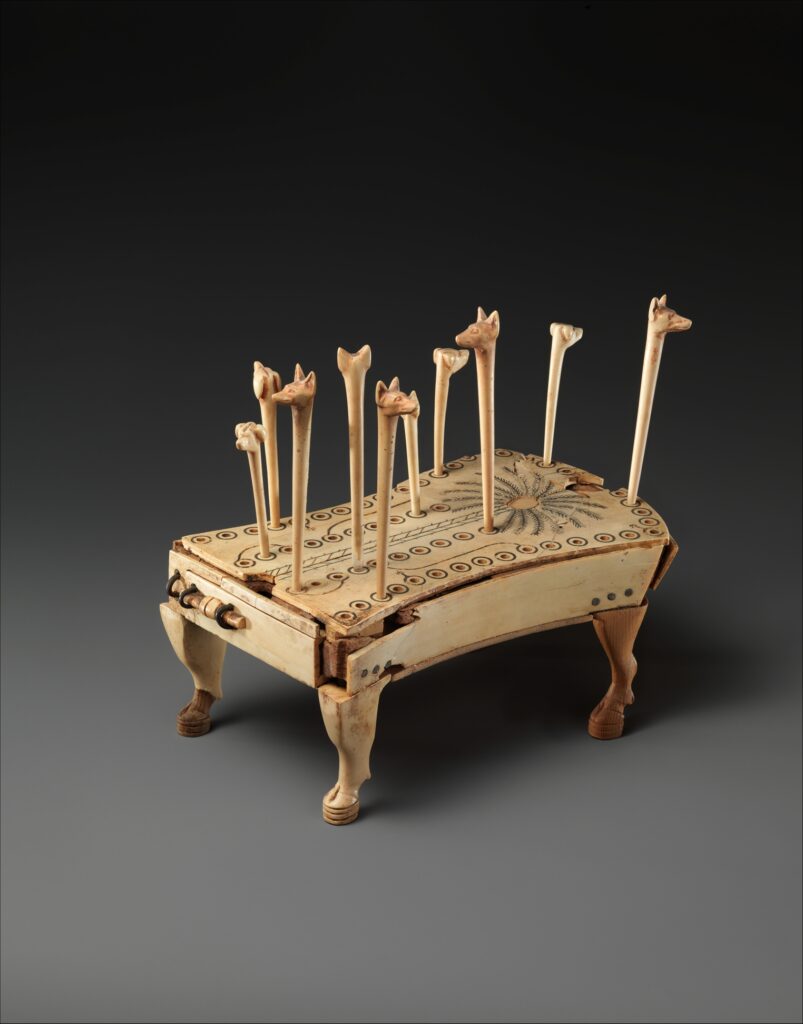
Figure 5. Game of 58 holes (“Hounds and Jackals”), from Thebes (Egypt), Asasif, Birabi, pit tomb CC 25, c. 1814–1805 BCE. Metropolitan Museum, New York, n. 26.7.1287a–k (public domain).
The game of 58 holes was practiced in the Near East from the second millennium until the first millennium BCE. Some boards were found associated with knucklebones, for example at Susa and Tepe Siālk in Iran. A late-antique version is attested in Coptic Egypt.
Only little more than twenty years ago, another type of game board has been discovered within the material found in the ancient cemeteries at Jiroft (Iran).25 Apart from boards for the “Game of 20 (squares)”, boards were found showing three rows of 12 squares, in some cases divided into two groups of six squares in each row. This material is usually dated to the middle/second half of the third millennium BCE. It is astonishing that the structure of these boards is identical to the one of Roman boards for the game of 12 points (“ludus duodecim scriptorum”), a game of the Backgammon family. Since most of these game boards were unearthed during illegal excavations, material such as game pieces or dice belonging to the game were not recovered.
Moving the Counters
What is astonishing is the fact that a mechanism to move the counters with the help of a random generator is more complicated than one which would simply give to the pieces the power to move by themselves. Would it not be much easier to determine that a piece can move one space forward (like the pawn in chess, the counters in draughts etc.) or one space in any direction (like the king in chess)? The use of a random generator adds a further mathematical operation to the structure of a board game. Any board game consists of three basic elements. First, a game board is necessary, divided by a mathematical/geometrical structure. Usually it comes as a division into so and so many squares26 or lines organised in a special way, in order to form or a one-dimensional track of a determined number of squares or a two-dimensional space (like a chess board of 8×8, a draughts board of 10×10 squares or a Go board of 19×19 lines). So for example the Egyptian game of Senet has a track of thirty squares arranged in 3 rows of 10 squares, the “Game of 20” has exactly twenty squares and a central row of exactly 12,27 the track of “Mehen” is arranged in a spiral, and the Jiroft game has exactly three rows of twelve resp. twice six squares (as the Roman games of XII scripta and Alea).
The counters, or more precisely a definite number of counters, which ought to pass through the track or to occupy a place or to move around on the space, constitute the second element. As a third element one needs to determine how the counters move on the board and what the final aim of their movements should be. As already stated, all the early board games of which some conclusions about their rules can be made, use random generators as a device to move the pieces. Such random generators can be of various kinds: one option is to use a number of two-sided objects, as for example cowrie shells or casting sticks. These last are easy to produce, in that one cuts a branch lengthwise so that one gets two pieces having a round (outer) and a flat (inner) side. You can use these sticks as dice by throwing for example 4 sticks and counting the flat sides turning up, giving 5 different results (1 flat side up, 2, 3 or 4 flat sides up, or 4 rounded sides up). The same system is applied when using cowrie shells with their rounded upper side and flat, open underside. The games found in the Predynastic graves in Ur were equipped with different types of random generators:28 Some had four-sided throwing sticks, others, as the famous so-called Royal game of Ur in the British Museum, came with tetrahedral dice. These little pyramids had two points colored and two points empty. The four-sided stick dice of about 6.5cm in length on the contrary, are marked by lines on one side and concentric circles at both ends of the other three sides. Both types are therefore binary dice:29 The players counted the colored points of the pyramids or the number of lined faces of the sticks. The chance for a pipped point turning up was therefore 2:2, while the chance of the lined faces turning up was only 1:3.
From the Indus Valley Civilisation similar tetrahedra are known, but also three- and four-sided long dice in a great variety.30 The most common type bears markings for 1, 2, and 3 points as well as lines on the fourth side,31 which means that values were attributed to the faces of the dice. Four wooden four-sided long dice with faces numbered 1 to 4 have been found at Shahr-e Suḵhte associated with the gaming board for “20 squares” and therefore dating to the middle of the third millennium BCE.32 Four-sided dice, albeit of a different shape, were also in use in the third and second millennia north of the Caucasus among the peoples of the Sea of Azov on the Don and Dnieper or in the steppes of the southern Urals, where the spots are indicated by notches in most cases.33 The attribution of values to the faces of one single object used as random generator is a new method that is also used for six-sided cubical dice, which are known since about the middle of the third millennium BCE. The die from the settlement Tepe Gawra near Mosul in northwestern Iraq, dating to around 2300 BCE is one of the earliest examples.34 It is fired from clay with slightly rounded edges worn by play and measures 24×23×20mm, so it is not perfectly cubic. The spots are drilled, with 1 facing 6, 2 facing 3 and 4 facing 5. Several examples have been found in Mohenjo-daro (Indus Valley) as well.35
Next, the application of the result needs counting: First, one counts the flat or rounded faces of sticks or the marked faces of four-sided long dice, the dotted points of tetrahedral dice or the number of dots on the faces of three-, four- or six-sided dice. As far as these last are concerned, after some time, the players will be able to simply read the result with the help of a particular arrangement of the spots on the faces or a symbol: So for example, on early cubic dice from Susa (Persia) two dots can be arranged either diagonally, or vertically, whereas three dots can be arranged diagonally, or vertically, or in a triangle. The 4-face has the four dots in the corners, 5 adds one dot in the center, 6 has parallel rows of 2 or 3 dots along the edges or is sometimes simply marked by a 36 cross or “diagonal line”. Instead of counting the six dots it was possible to identify the symbol “cross” or “diagonal line” as representing the value 6.
A somewhat similar method seems to me the attribution of values to the four faces of a knucklebone.37 Knucklebones in association with board games of Senet and “The Game of 20 (squares)” are attested in Egypt in the second millennium BCE. The Metropolitan Museum of Art preserves a double-sided games box for Senet/Twenty squares with playing pieces and a pair of knucklebones from Thebes (inv. n. 6.10.475a), dating to ca. 1635–1458 BCE. Tutankhamun’s tomb (he died 1323 BCE) provided games box n. 345 (on stand) with four sticks and two knucklebones, games box n. 393 with playing pieces and one knucklebone, and games box n. 593 including 38 playing pieces and two knucklebones.38 In order to use a knucklebone as a die, values must be given to the four different faces (comp. Pollux, Onomastikon, IX 99-100), or by using dots as on cubical dice or by distinguishing the faces through their particular shape: one side is broad and rounded (called “belly” by Aristotle), the opposite side is hollowed (called “back” by Aristotle),39 another side has an s-shaped form, while its opposite side resembles a human ear. Although the former method is attested, there are not many examples of knucklebones with dots or drilled holes to indicate the values.40 More common are astragals without any markings on their faces, so that the result cannot be detected by counting spots, but by associating a value with a specific shape. This method was already used in Tutankhamun’s times, as the blank knucklebones from his games boxes betray. Since classical Greece, the values 1 opposite 6 attributed to the smaller faces and 3 opposite 4 given to the “belly” and the “back” with 2 and 5 missing referred to the numbering of the faces of the six-sided die, which would become a standard in Roman times.
It is likely that the results of all such random generators — there was no modern notion of random in ancient civilizations — were regarded as finally expressing divine will. However, with their number of possible outcomes and values being limited, “the Gods” had a restricted number of options, which enabled the players to anticipate what was to come, although it was impossible to predict the outcome of the rolls precisely.
Remarkable in our context is Irving Finkel’s observation that in the Sumerian language the common word for knucklebone (or astragal) is zin-gi, which literally means gaming piece-mover (zin = 41 gaming piece, gi = to control or to drive).41 This indicates that for the Sumerians it was natural that a gaming piece needed a device to be moved and could not do so by itself.
Finally, the result of this operation must be applied to the movement of the piece(s) on the board by counting the number of squares.
As far as I tell, nobody has ever asked why a more complicated system to determine the moves of pieces on a game board appears prior to an easier one. It is a complex process to imagine and invent a random generator. It is possible that such procedures procuring random results were already used for decision making, as some centuries later the casting and drawing of lots in Homer’s Iliad (III, 315; III, 324; VII, 171; XXIII, 352; XXIII, 860; XXIV, 400) and Odyssey (IX, 331). Random results and procedures to provide them are also needed for divination purposes, but are divination procedures attested prior to the appearance of board games? Moreover, only binary dice with their values 0 and 1 could respond to questions requiring a yes or a no, while other numeric devices would only give answers to questions of the kind “how many,” but hardly to other questions about life, love, health, travel, business and the like.
Egyptian Counters
Let us now have a look at gaming pieces.42 The counters used by players in ancient Egypt, Mesopotamia and the Indus Valley were mostly non-figural. In Egypt, the earlier ones were thimble-shaped with a flat separated top, or spool-shaped, later ones are dome-shaped with or without a knob on top. Some are mushroom-shaped and others similar to modern Halma pawns.43 Crouching (!) lionesses were obviously part of the Mehen game, as shown by the wall-painting in Hesy-Re’s tomb (fig.1). Some of the games of 58 holes had pegs with dogs’ and jackals’ heads, such as the game from Thebes in the Metropolitan Museum New York, dating to the 12th dynasty, therefore called “Hounds and Jackals” by its excavator Howard Carter (fig. 5).44 Other gaming pieces come in the shape of Bes (seated or just the head), human or animals’ heads. Figurines of archers and flute-players are also interpreted as gaming pieces.45 These gaming pieces of deities, 45 men and animals date from the 18th (spanned the period from 1550/1549 to 1292 ) to the 26th (664 525 BCE) dynasties, i.e. they appear relatively late.46
Of particular interest in our context are Egyptian gaming pieces in the shape of human captives (fig. 6):47 Kneeling with their arms tied behind their back, they refer to statues of kneeling foreign prisoners coming up in the mid-5th dynasty (c. 2400 BCE) and are often dated to the second half of the second millennium BCE and until the early first millennium BCE. It is obvious that such figures are totally immobile and unable to do anything. Therefore it is astonishing that such a form was chosen for a gaming piece conceived to move around a game board. It is a perfect image of the idea that such a piece needs a stimulus from outside.
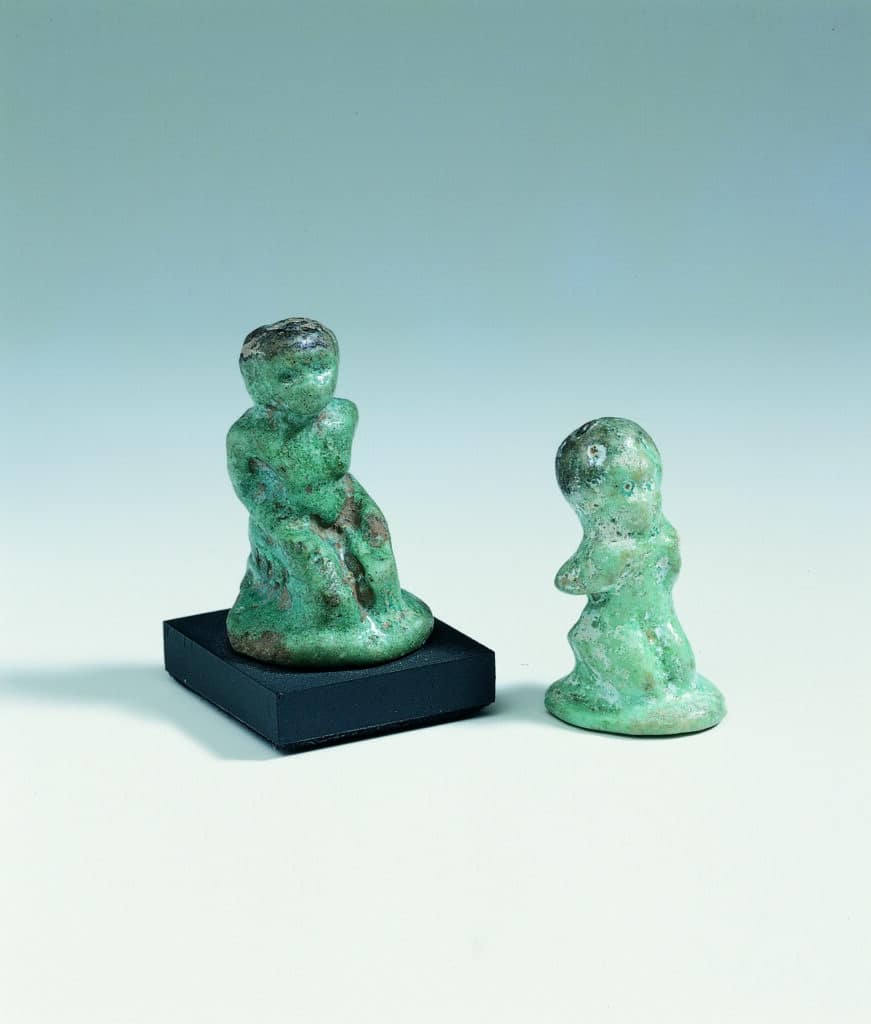
Figure 6. Gaming counters in the shape of prisoners, faïence, Egypt, 16th – 8th century BCE, Swiss Museum of Games, La Tour-de-Peilz, inv. 2557, 2758 (photograph P. Caverzasio).
The silhouette of gaming pieces of the tall cone type is used, already since the second quarter of the third millennium BCE (5th dynasty), as an element of the hieroglyphic sign for ꞽbꜣ (“iba”) “to dance”, thus indicating that these pieces moved. On a wall painting in the tomb of Rashepses (chamber B, southside; 5th dynasty) a row of dancers is depicted.48 “Dances of the gods” are mentioned in a letter by King Neferkare (Pepi II) on the facade of the tomb of Harkhuf (Harchuf: hr-hwf) at Qubbet el Hawa near Aswan (6th dynasty, last quarter of the third mill. BCE).49 In both cases the hieroglyphic inscription contains the typical outlines of gaming pieces as shown in the scene with the two Senet players on the wall painting of Rashepses, in a gaming scene in the tomb of Pepyankh (Meir, c.2300 BCE, time of Pepi II)50 and others.51 An example of such a gaming piece is preserved in the Louvre.52
It is still unclear whether the name “dancers” was applied from dancers to the pawns or vice versa. Since ptolemaic times gaming pieces are called “dogs” in Babylonia as well as in Egypt and in Greece (see Pollux, Onomastikon 9.98-99; Eustathius, Iliad 1290.1-3; Odyssee 1397.44-48).53 Perhaps this allusion to dogs was motivated by their behavior, which consists of spending most of the day sleeping, interrupted only by phases of activity in the search for food or to play with others of the pack. This is very similar to pawns on a game board, which also remain standing on a square for a long time waiting to finally be moved.
Only in Roman times the pieces were identified with humans: one Roman game of strategy similar or identical to the Greek game Polis was the “ludus latrunculorum” — the game of little soldiers.54
Let us resume the principal observations and theses discussed in the preceding lines. To judge from the available archaeological sources, the earliest board games from the mid fourth millennium BCE onwards were games involving a random generator to determine the moves of the pieces. The application of such a mathematical device appears to be more complicated than simply letting the pieces move by themselves. In the light of Julian Jaynes’ theories, it looks as if it was not imaginable for bicameral players that a gaming piece should be able to autonomously move around on the game board. It needed an external “piece mover”. It seems to me that there is an analogy in the behavior of bicameral men and their gaming pieces. It took until the fifth century BCE, when in ancient Greece a board game called Polis (city states) was developed with pieces (called “dogs”) possessing an inherent power to move one or more squares at a time and to capture opponent pieces. This coincides with the period when in ancient Greece the evolution of modern consciousness in Jaynesian terms came to a conclusion, a process Jaynes revealed on the basis of observations in the Iliad, the Odyssey and the pre-socratic philosophers (Jaynes, Ch. 3, p. 255-292).
Notes
- Rollefson 1992, 1-5; Simpson, 2007, p. 5-10.
- Depaulis 2020.
- Bardiès-Fronty / Dunn-Vaturi 2012, p. 40-41 fig.1; Crist / Dunn-Vaturi / de Voogt 2016, p. 43. Ayrton / Loat 1911, p. 30., pl. XVII 1,4.
- Crist 2021, 14-15.
- Woolley 1934, p. 274-279, p. 540, 548, 557, 559, 567. For Mesopotamia in general see: Allinger-Csollich 2003.
- Piperno / Salvatori 1983, p. 179-89, figs. 5-7, pl. VI. For Iran see Dunn-Vaturi / Schädler 2016, accessible at http://www.iranicaonline.org/articles/board-games-in-pre-islamic-persia.
- Majidzāda 2003.
- Dunn-Vaturi / Schädler 2006, p. 1-29.
- See for example Wilfried Allinger-Csollich 2003, p. 7-45.
- The term has been used by Harold J.R. Murray in his classification of traditional board games: See Murray, 1913, and Murray 1952, 4-5. It does not mean that these games were intended to imitate a race. See Schädler (forthcoming).
- For the game of Polis see Schädler 2002 and Nelson 2020 muse.jhu.edu/article/773364.
- Masters 2023/2024 and 2024. Earlier studies include Flinders Petrie / Quibell 1896, p. 42, pl. XLIII; Ranke 1920; Pierini 1991, p. 125-129; Rothöhler 1999; Kendall 2007; Crist 2021, p. 15.
- Pusch 2007, p. 83, 84. See for example: Newell 1883, p. 147.
- Emery 1954, Saqqara II, Tomb n° 3504, p. 56-59.
- Bell 1969, vol.1, p. 12-14.
- Summary by Crist 2021, pp. 13-15. Kendall / May, 1991; Kendall 1978; Piccione 2007; Crist-DunnVaturi-de Voogt, p. 41-67; Crist 2019.
- Crist / Dunn-Vaturi / de Voogt 2016, 81; Pusch 2007; Finkel 2007.
- Woolley 1934.
- Majidzāda 2003; Dunn-Vaturi / Schädler 2006, 3-7.
- Finkel 1995, p. 64-72; Finkel 2007, p. 16-32.
- http://www.griffith.ox.ac.uk/perl/gi-ca-qmakeres.pl?sid=62.167.105.179-1618761518&qno=1&sta=0&qtx=game
- Pusch 1977, p. 199-212. An extraordinary wooden board for the game of twice 20 squares was found in the funerary temple of 6th dynasty pharaoh Teti’s life Nearit (or Neith) at Sakkara “besides plenty of board games the deceased would play with in the afterlife”, as announced in the Luxor Times Magazine on Facebook on Jan.16, 2021, see: https://www.facebook.com/photo/?fbid=1550803028439536&set=pcb.1550805468439292.
- Quibell 1913, 18-21 pl. XI; Ranke 1920, p. 3; May 1991, p. 141 ill. 125; Crist-Dunn-Vaturi-de Voogt 2016, p. 37-38; Williams / Seele 1986, p. 130 pl. 66-67.
- The Game of Hounds and Jackals: From Thebes to Susa, in: Crist / Dunn-Vaturi / de Voogt 2016, p. 103-124; Dunn-Vaturi 2012, p. 58-59; Hoerth 2007, p. 64-68.
- Majidzāda 2003; Dunn-Vaturi / Schädler 2006. For the Roman game see: Schädler 1995.
- With “square” I intend any space used to hold a counter. Such a space does not necessarily need to have the geometrical form of a square. Mancala games usually have more or less half round cavities; Roman game boards for “XII scripta” show all kinds of symbols, letters, circular, rectangular or square spaces; the Greek game of “Five Lines” uses a board with parallel lines, with the counters placed on the ends of the lines, sometimes marked by a circle or small cavity; in games such as Go, Alquerque or Nine men’s morris, the counters are placed on the intersections of lines.
- Except for some of the Scorpion-shaped boards from Jiroft (see above) with only eight squares in the central row.
- Woolley 1934, p. 278-279.
- Finkel 2007, p. 17, however, says that these dice are four-sided and would bear values one to four.
- Rogersdotter 2011, 137-139 with ref. to Mackay1931, p. 551-52 with pl. CLIII, 7-10, and Mackay 1938, p. 559-560 cubical dice: pls. CXXXIX, 20; CXL, 19, 20, 63; CXLII, 84-86: 7 cubical dice; p. 560-562 tabular dice, rectangular and triangular in section, pl. CXXXVIII, CXLIII.
- Rogersdotter 2011, p. 137-139.
- Piperno / Salvatori 1983, p. 179 ff., fig. 7.
- Klejn 1997; Stefanov et al. 2016.
- Mecquenem 1943, p. 46.
- Rogersdotter 2011, p. 137-38.
- Dunn-Vaturi / Schädler 2016.
- Schädler 1996, p. 63-65; Vespa 2021. Contrary to what Peter Bernstein wrote (Against the Gods: The Remarkable Story of Risk, Wiley, New York et al., 1996, p. 12), the knucklebone is not the oldest form of dice.
- http://www.griffith.ox.ac.uk/perl/gi-ca-qmakeres.pl?sid=62.167.105.179-1619025182&qno=1&sta=0&qtx=game (retrieved 2021-04-21). See also Tait 1982.
- Aristotle, Hist. anim. II.1 p. 499b, 28sqq.; Schädler 1996, 64 with footnote 15.
- One example is an astragal with drilled holes indicating the values 1, 2, 3 and 4 found in a grave in Katsamba (Crete) dating to the middle of the 2 nd millennium BCE: Alexiou 1967, p. 39, 58, pl. 36γ; Hillbom 2005, p. 313-14 with fig. 18. Examples from the Near East (see Dunn-Vaturi / Schädler 2016) include two bone knucklebones with one hole in the broad sides dating to the 12th century BCE from Susa (Mecquenem 1943, p. 46, fig. 40, nos. 9-12), as well as from Denḵā Tepe in Azerbaijan (Muscarella 1974, p. 80). From Nuš-e Jān (Iran) come several knucklebones (Curtis 1984, p. 48, fig. 16, nos. 432-34) with small holes to indicate the values of the four sides: the smaller faces have 4 and 3 holes respectively, whereas the broad faces count 2 or 0 and 1 point respectively. A similar numbering has been observed on a knucklebone from Geoy Tepe near Urmia in western Azerbaijan, dating from the pre-Islamic Iron Age period: it has one hole in the “back” (as the one from Nuš-e Jān) and two holes in the “ear” (Burton Brown 1951, p. 175, pl. XIII.1531). Dunn-Vaturi / Schädler 2016. An astragal from Thasos has also small drilled holes on its four sides: three on the broad convex side (plantar), four on the opposite concave broad side (dorsal), one on the small side (lateral) and six on the opposite small side resembling an ear (medial): Kozelj/Wurch-Kozelj 2012, pp. 26-27 fig 1.
- Personal communication from Irving Finkel, whom I heartily thank for this information and all the discussions we had and do have about the history of games.
- Summary in Crist / Dunn-Vaturi / de Voogt 2016, p. 64-67.
- See a.e. Emery 1954, pl. XXIX (Sakkara, tomb 3504); Petrie 1927, p. 53-54, pl. XLVIII; Towry-Whyte 1902. Compare the playing pieces from Mohenjo-daro: Mackay 1931, pls. CLIII, CLV, and Mackay 1938, pls. CXL, CXLII.
- Dunn-Vaturi 2000, 107-111.
- For illustrations of Egyptian and Mesopotamian gaming pieces see for example Bardiès-Fronty / Dunn-Vaturi 2012, p. 47-49, 53-57.
- Towry-Whyte 1902; Nash.
- See a.e.: Dunn-Vaturi 2007, ill.p. 20, p.24; Bardiès-Fronty / Dunn-Vaturi 2012, p. 48-49; 120, ill. p. 120, n° 7; Franco 2004, p. 229 n° 128.
- Lepsius 1897, p.165-170 LS 16, pl. 61b.
- Erman 1893; Nash 1902, 344-45.
- Piccione 1980, 55-58, fig. 2.
- Crist / Dunn-Vaturi / de Voogt t 2016, p. 48 fig. 3.3; Piccione 2007, p. 60 figs. 6.2 and 6.3.
- May 1991, p. 144 fig.129; inv. E 22649, dating to the Old Kingdom.
- Finkel 1995, Finkel 2007; Crist / Dunn-Vaturi / de Voogt 2016, p. 66.
- For this game see: Schädler 1994.
Bibliography and Further Reading
Stylianos Alexiou, Ysterominoikoi Taphoi Limenos Knosou (Katsampa), Athens 1967.
Wilfried Allinger-Csollich, Stratifizierte Brettspiele aus Babylonien, Nikephoros 16, 2003, p. 7-45.
Edward Russell Ayrton, William Leonard Stevenson Loat, Pre-dynastic cemetery at El Mahasna, London 1911.
Isabelle Bardiès-Fronty / Anne-Elizabeth Dunn-Vaturi (eds), Art du jeu, jeu dans l’art : de Babylone à l’Occident médiéval, cat. exp. (Paris, Musée de Cluny-musée national du Moyen-Age, du 28 novembre 2012 au 4 mars 2013), Réunion des musées nationaux-Grand Palais, Paris 2012.
Robert Charles Bell, Board and Table Games from Many Civilizations, vol. I, Oxford 1969.
Wim van Binsbergen, Board-games and divination in global cultural history, a theoretical, comparative and historical perspective on mankala and geomancy in Africa and Asia (1999). Avaliable at: https://www.quest-journal.net/shikanda/ancient_models/gen3/mankala/mankala1.htm.
Aylward Manley Blackman, Michael R. Apted, The rock tombs of Meir: Part I: The tomb of Pepyankh the middle. London: Egypt Exploration Society 1914.
Aylward Manley Blackman, The Rock Tombs of Meir IV: The Tomb-chapel of Pepi‛onkh the Middle Son of SebkHotpe and. Pekhernefret (D, no. 2), London 1924.
Maya Burger, Climb the Ladder, Draw the Future, Hit the Bingo: Randomness, Divination and Luck, in: Philippe Bornet, Maya Burger (eds), Religions in Play. Games, Rituals, and Virtual Worlds, Zürich 2012, p. 83-92.
T. Burton Brown, Excavations in Azarbaijan, 1948, London 1951.
Walter Crist, Anne-Elizabeth Dunn-Vaturi, Alexander J. de Voogt, Ancient Egyptians at Play, New York 2016.
Walter Crist, Passing from the Middle to the New Kingdom: A Senet Board in the Rosicrucian Egyptian Museum, Journal of Egyptian Archaeology 105(1), 2019, p. 107-113.
Walter Crist, “Debunking the Diffusion of Senet,” Board Game Studies Journal, vol.15, no.1, 2021, pp.13-27. https://doi.org/10.2478/bgs-2021-0002.
Stewart Culin, Chess and Playing Cards, From the Report of the U.S. National Museum for 1896, Washington 1898.
John Curtis, Nush-i Jan III. The Small Finds, London 1984.
Thierry Depaulis, Board Games Before Ur?, Board Game Studies Journal 14.1, 2020, p. 127-144. https://doi.org/10.2478/bgs-2020-0007.
Anne-Elizabeth Dunn-Vaturi, The „Monkey Race“ — Remarks on Board Game Accessories, Board Games Studies 3, 2000, 107-111.
Anne-Elizabeth Dunn-Vaturi, Ulrich Schädler, Nouvelles perspectives sur les jeux à la lumière de plateaux du Kerman, Iranica Antiqua 41, 2006, p. 1-29.
Anne-Elizabeth Dunn-Vaturi, Course-poursuite dans l’Antiquité, in: Ulrich Schädler (ed.), Jeux de l’Humanité. 5000 ans d’histoire culturelle des jeux de société, Genève 2007, 20-29.
Anne-Elizabeth Dunn-Vaturi, Le jeu du chien et du chacal, in: Bardiès-Fronty/Dunn-Vaturi 2012, p. 58-59.
Anne-Elizabeth Dunn-Vaturi, Ulrich Schädler, “Board Games in pre-Islamic Persia”, Encyclopædia Iranica, online edition, 2016, available at http://www.iranicaonline.org/articles/board-games-in-pre-islamic-persia .
Hany El-Tayeb, Some Rare Scenes in the Tomb of Rashepses at Saqqara, in: The art of describing: the world of tomb decoration as visual culture of the Old Kingdom : studies in honour of Yvonne Harpur / edited by Peter Jánosi and Hana Vymazalová, Prague 2018, p. 289-307.
Walter Bryan Emery, Excavations at Saqqara. Great tombs of the 1st dynasty, II, London 1954.
Adolf Erman, Zur Inschrift des Ḥr-ḫwf, Zeitschrift für ägyptische Sprache und Alterthumskunde 30, 1892, p. 78-83.
Adolf Erman, Der Brief des Königs Nefr-keȝ-re’ , Zeitschrift für ägyptische Sprache und Alterthumskunde 31, 1893, p. 65-73.
Irving Finkel, On the Rules of the Royal Game of Ur, in: Irving L. Finkel (ed.), Ancient Board Games in perspective, London 2007, p. 16-32.
Irving Finkel, Board Games and Fortune Teling: A Case from Antiquity, in: Alexander J. de Voogt (ed.), New Approaches to Board Games Research, Leiden 1995, p. 64-72.
Irving Finkel, On the rules for the Royal Game of Ur, Irving L. Finkel (ed.), Ancient Board Games in perspective, London 2007, p. 16-32.
William M. Flinders Petrie, James Edward Quibell, Naqada and Ballas. 1895, London 1896.
William M. Flinders Petrie, The Royal Tombs of the Earliest Dynasties, 1901, vol. II, London 1901.
William M. Flinders Petrie, Objects of Daily Use, London 1927.
I. Franco, Pions de jeu en forme de prisonniers, in: Christiane Ziegler, Sophie Labbé-Toutée (dir.), Pharaon, Cat. exp. (Paris, Institut du monde arabe, 15 oct. 2004 au 10 avril 2005), Paris 2004, 229.
Niklas Hillbom, Minoan games and game boards, Lund 2005.
A.J. Hoerth, The Game of Hounds and Jackals, in: Irving L. Finkel (ed.), Ancient Board Games in perspective, London 2007, p. 64-68.
Naguib Kanawati, Linda Evans, The cemetery of Meir I: The tomb of Pepyankh the Middle. Oxford 2012.
Timothy Kendall, The Ancient Egyptian Game of the Serpent, in: Irving L. Finkel (ed.), Ancient Board Games in perspective, London 2007, p. 33-45.
Timothy Kendall, Roland May, Le jeu de “Senet”, in : Roland May (dir.), Jouer dans l’Antiquité, Musées de Marseille 1991, p. 130-147.
Timothy Kendall, Passing through the Netherworld: the meaning and play of Senet, an ancient Egyptian funerary game, Belmont, Mass. 1978.
Leo Klejn, The origin of zero: the evolution of dice game between Indus and Danube, Stratum plus. Archaeology and Cultural Anthropology, 1997, p. 47-66.
Anton Koželj, Manuela Wurch-Koželj, Quelques jeux antiques identifiés à Thasos, Historia Antiqua 21, 2012, p. 25-38.
Carl Richard Lepsius, Denkmäler aus Ägypten und Äthiopien, Erster Textband, hrsg. von Eduard Naville, bearb. von Kurt Sethe, Leipzig 1897.
Ernest John Henry Mackay, „Games and Toys“ in: John Marshall, Mohenjo-daro And The Indus Civilization Vol-ii, London 1931, p. 549-561.
Ernest John Henry Mackay, Further Excavations at Mohenjo-daro, 2 vols., Delhi 1938.
Youssef Majidzāda, Jiroft: kohantarin tamaddon-e šarq/Jiroft: The Earliest Oriental Civilization, Tehran 2003.
James Masters, Mehen, The Ancient Egyptian Serpent Game: A Reappraisal of Game-play Theories, Birmingham Egyptology Journal 10.1, 2023/2024, 52-87.
James Masters, Mehen, The Ancient Egyptian Serpent Game. A Reappraisal of the Evidence Set, Interdisciplinary Egyptology, 3.2, 2024,1-50 doi: 10.25365/integ.2024.v3.2.
Roland de Mecquenem, Mémoires de la Délégation en Perse 29, Paris 1943.
Harold James Ruthven Murray, A History of Chess, Oxford 1913.
Harold James Ruthven Murray,, A History of Board Games Other Than Chess, Oxford 1952.
Oscar White Muscarella, “The Iron Age at Dinkha Tepe, Iran,” Metropolitan Museum Journal 9, 1974, p. 35-90.
Walter L. Nash, Ancient Egyptian Draughts-Boards and Draughts-Men, Proceedings of the Society of Biblical Archaeology 24, 1902, p. 341-348.
Max Nelson, “Battling on Boards: The Ancient Greek War Games of Ship-Battle (Naumachia) and City-State (Polis).” Mouseion: Journal of the Classical Association of Canada 61.1, 2020, 3-42. muse.jhu.edu/article/773364
William Wells Newell, Games and Songs of American children, New York 1883.
Peter A. Piccione, The Egyptian Game of Senet and the Migration of the Soul, in: Irving L. Finkel (ed.), Ancient Board Games in perspective, London 2007, p. 54-63.
Peter Piccione, In search of the meaning of Senet, Archaeology 33, August 1980, p. 55-58.
Gisèle Pierini, in: Jouer dans l’Antiquité, Musées de Marseille 1991, p. 125-129.
Marcello Piperno, Sandro Salvatori, Recent Results and New Perspectives from the Research at the Graveyard of Shahr-i Sokhta, Sistan, Iran, Annali 63, 1983, p. 172-91.
Edgar Pusch, “The Egyptian ‘Game of Twenty Squares’: Is it Related to ‘Marbles’ and the Game of the Snake?” in: Irving L. Finkel (ed.), Ancient Board Games in Perspective, London 2007, p. 69-86.
Edgar Pusch, Eine unbeachtete Brettspielart, in: H. Altenmüller and D. Wildung (eds), Studien zur altägyptischen Kultur, vol. 5, Hamburg 1977, p. 199-212.
James Edward Quibell, Excavations at Saqqara (1911-1912): The Tomb Of Hesy, Cairo 1913.
Hermann Ranke, Das altägyptische Schlangenspiel, Heidelberg 1920.
Elke Rogersdotter, Gaming in Mohenjo-daro – An Archaeology of Unities, Göteborg 2011.
Benedikt Rothöhler, Mehen. God of the Boardgames, Board Games Studies 2, 1999, p. 10-22.
Gary O. Rollefson, A Neolithic game board from ‘Ain Ghazal, (Jordan)’, Bull. Of the American School of Oriental Research 286, 1992, 1-5.
Ulrich Schädler, Spielen mit Astragalen, Archäologischer Anzeiger 1996, 61-73.
Ulrich Schädler, XII Scripta, Alea, Tabula – New Evidence for the Roman History of “Backgammon”, in: Alexander J. de Voogt (ed.), New Approaches to Board Games Research, Leiden 1995, p. 73-98.
Ulrich Schädler, The Talmud, Firdausi, and the Greek game “City”, in: Jean Retschitzki, Rosita Haddad-Zubel (eds), Step by Step. Proceedings of the 4th Colloquium Board Games in Academia, Fribourg 2002, p. 91-102.
Ulrich Schädler, H.J.R. Murray’s Classification of Board Games, in: Fabio Spadini (ed.), Mélanges Dasen, Münster (forthcoming).
Stuart John Simpson, Homo Ludens. The Earliest Board Games in the Near East, in: Irving L. Finkel (ed.), Ancient Board Games in perspective, London 2007, p. 5-10.
Vladimir I. Stefanov et al., Evolution of the Ancient Game of Dice: Sources from the Late Bronze Age, Stratum plus 2, 2016, 235-253 (also as: Evolución del juego antiguo con dados: fuentes de la Edad del Bronce Final en las estepas euroasiáticas, Arpi 5, 2016, p. 61-78).
William John Tait, Game Boxes and Accessories from the Tomb of Tutankhamun, Oxford 1982.
Edward Towry-Whyte, Types of Egyptian Draughts-men, Proceedings of the Society of Biblical Archaeology 24, (June), 1902, p. 261-63.
Bruce Williams, Keith Cedric Seele, The A-Group royal cemetery at Qustul: cemetery L. Vol. 3. Oriental Institute of the University of Chicago, 1986.
Marco Vespa, Venere e gli astragali. Una nuova interpretazione del basilicus iactus in Plauto, Curculio, 349-361, ACME 74.2. 2021, p. 7-22. DOI http://dx.doi.org/10.54103/2282-0035/18660
Charles Leonard Woolley, Ur Excavations vol. II: The Royal Cemetery, New York 1934.
Learn more about Julian Jaynes’s theory by joining the Julian Jaynes Society and reading our books.