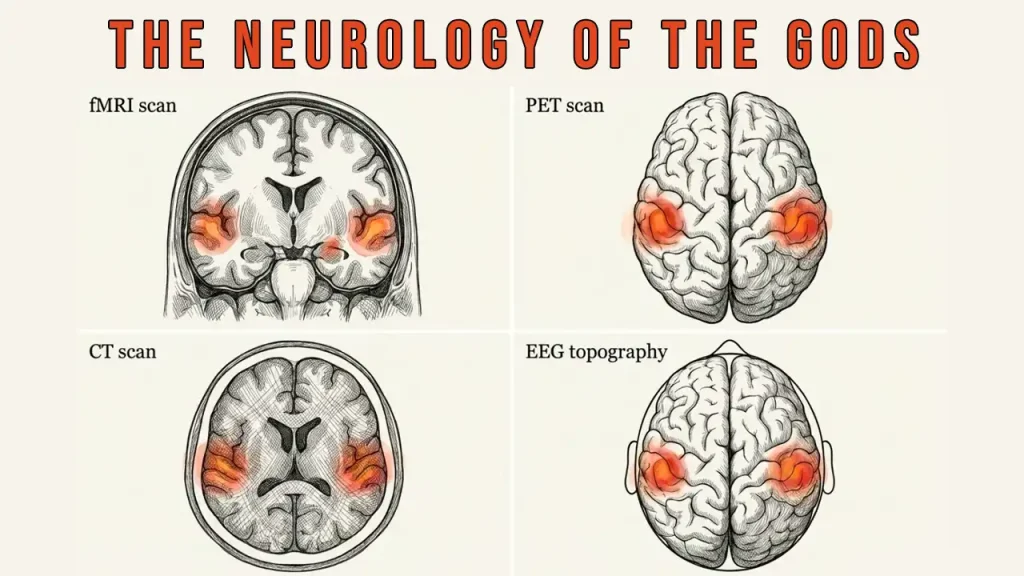
The Neurology of the Gods
The Origin of the Conscious Mind
In 1976, Princeton University psychologist Julian Jaynes published a thesis arguing that human consciousness is a recently learned process. Before its development, he claimed, our ancestors operated under a bicameral or two-chambered mentality, where stress-induced auditory hallucinations directed their behavior.
Jaynes’ fourth hypothesis provided a specific neurological model for this process. He argued the brain utilized its language centers to transmit stress-induced information between the two hemispheres, creating the internal voices of ancient gods and kings.
This was a precise, localized, neuroanatomical claim. Jaynes identified exactly where these hallucinations should originate decades before the invention of functional brain imaging, meaning he had no technological means to verify his own deduction.
Through the comprehensive data compiled by Marcel Kuijsten and the Julian Jaynes Society, we can now see how modern neuroscience has inadvertently tested this 40-year-old theory. What began as a historical deduction is now being measured against contemporary clinical observations.
To understand the mechanism Jaynes proposed, we look at the architecture of the modern human brain. In most people, language processing is heavily dominant in the left hemisphere, specifically within Wernicke’s and Broca’s areas.
The primary connection between these hemispheres is the corpus callosum, a thick band of nerve fibers that facilitates interhemispheric communication. Jaynes deduced that auditory verbal hallucinations are generated in the right hemisphere homologs, the dormant silent mirror image areas of our active language centers.
In this model, the hallucinatory signal travels from the right hemisphere across the corpus callosum, where it is received and “heard” by the language areas of the left hemisphere. Because this signal originates outside the centers associated with the conscious self, the subject perceives the voice as an external, commanding entity, a god or a chief, rather than an internal thought.
If Jaynes’ theory is correct, modern brain scans of patients experiencing these hallucinations must show this exact right-to-left interaction. The development of real-time functional brain imaging in the late 1990s allowed researchers to finally monitor the localized activity of a hallucinating brain.
A 1999 study by psychiatrist Belinda Lennox achieved this by having a patient inside an fMRI press a button at the onset of a hallucination. The scans showed activation beginning precisely in the right middle temporal gyrus, before extending to the left superior temporal gyrus.
Buchsbaum’s PET scans and the Jardri study confirmed this bilateral temporal lobe activation, documenting the involvement of both hemispheres during hallucinatory events.
By 2016, a quantitative meta-analysis by Leor Zmigrod integrated data from across the field, establishing a consensus that auditory hallucinations utilize the right hemisphere homolog of Broca’s area. Across separate labs and different technologies, neuroimaging has traced the specific pathway Jaynes proposed.
Further evidence appears in the “lateralization index,” which measures how language processing is distributed between the left and right hemispheres. This scatter plot illustrates Dr. Iris Sommer’s research tracking the relationship between brain asymmetry and hallucination frequency. The data shows a correlation. Patients processing language more evenly across both hemispheres, indicating higher right brain involvement, are more likely to experience auditory hallucinations.
This is mirrored in cases of temporal lobe epilepsy, where abnormal electrical activity in the right temporal lobe can trigger intense auditory and visual experiences. When the brain’s language architecture shifts away from strict left hemisphere dominance, the dormant capacity of the right hemisphere to generate voices becomes active.
The biological capacity for two independent spheres of cognition is visible in a surgical treatment for severe epilepsy called commissurotomy, which severs the corpus callosum. Pioneering researchers like Sperry, Gazzaniga, and Bogen studied these patients to understand how the brain functions when its two halves are disconnected. They found that the two hemispheres exhibit independent agency, possessing different preferences, and distinct spheres of awareness. This independence can lead to alien physical actions, where the right hemisphere initiates a movement that the conscious, language-dominant left hemisphere does not authorize or understand.
Philosopher Elizabeth Schechter’s analysis suggests that split-brain patients confirm the human skull can host a conscious duality, despite outward behavioral unity.
Cases of hemispherectomies, the removal of half the brain, further prove that a single hemisphere is sufficient to maintain a complete self. These surgical realities demonstrate that the brain’s hardware is fundamentally capable of the two-chambered operation described in the bicameral mind theory.
We see this supported by three pillars of evidence: the fMRI mapping of right-to-left signals, the correlation between language lateralization and hallucinations, and the cognitive duality observed in split-brain patients.
Dr. Robert Olin wrote in The Lancet that “neuroimaging has confirmed the importance of Jaynes’ hypothesis,” while Dr. Leo Sher noted that “modern data has successfully revived this controversial model.”
The definitive record of this research is found in Conversations on Consciousness and the Bicameral Mind, edited by Marcel Kuijsten. This volume features exclusive interviews with the psychiatrists and neuroscientists who have verified this data. Follow the link in the description to purchase your copy.
The voices of the ancient gods were not a myth, but a neurological mechanism that remains active in the human brain today.