The Origin of Religion Explained
The Neurological Origin of the Gods
Look at the ancient world globally, and you find a consistent strange anomaly. Geographically isolated civilizations, separated by oceans and continents, all independently developed identical religious behaviors. They built massive mortuary architecture. They fed and clothed statues, and they organized their societies around the daily commands of invisible deities.
Standard anthropology struggles to explain this uniformity, treating early religion as a primitive attempt at science, a way to explain thunder and lightning, or merely as an arbitrary tool for social cohesion, fails to account for the highly specific, mechanical rituals these ancient societies demanded.
The philosopher David C. Stove pointed out that ignoring the reality of these early religious practices is to put aside 9/10 of human history. To understand our ancestors, we need a framework proportional to the scale of their devotion, which is exactly what the psychologist Julian Jaynes provided.
Evolutionary biologist Richard Dawkins noted in The God Delusion that Jaynes’s work is quite possibly the best explanation for the origin of religion we have. For Julian Jaynes, early religion originated as a universally experienced, neurological reality that governed every waking moment of human existence, rather than a set of invented cultural concepts or philosophical beliefs.
Jaynes called this operating system the “bicameral mentality.” He argued that prior to the late second millennium BC, human beings completely lacked subjective consciousness. They possessed no introspective mind-space, no internal monologue, no sense of an independent self.
Instead, the brains of early urban populations functioned as two distinct chambers. When an individual faced the stress of a complex decision or a novel situation, executive commands were generated in the right hemisphere, specifically the right temporal lobe.
These neural signals traveled across the anterior commissure to the left hemisphere. The individual experienced this transmission not as a thought, but as a literal hallucinated voice — an auditory command perceived as the voice of a god, an ancestor, or a ruler. The left hemisphere acted strictly as the follower. It received the hallucinated command and immediately executed the required behavior without hesitation or internal debate.
Early humans were biological automatons. Their societies operated as highly coordinated networks steered entirely by the hallucinated voices of their neurological superiors. This neurological reality explains the massive physical footprint of early civilizations.
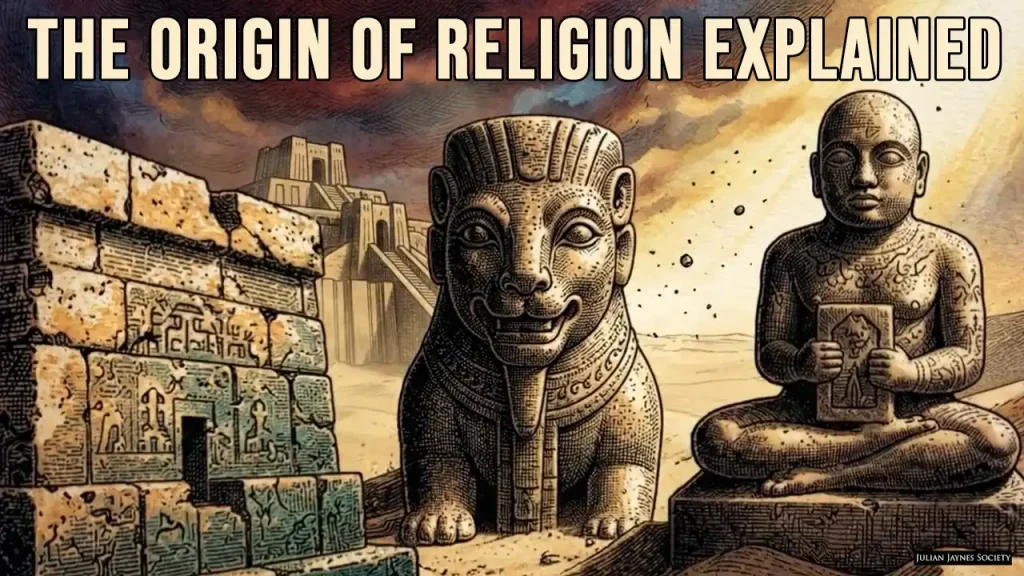
Structures like ziggurats in Mesopotamia and pyramids in Egypt dominated the ancient landscape.
Observers often mistake these structures for monuments to human vanity. They served instead as functional, literal houses for the gods built to maintain the acoustic and social proximity required for auditory hallucinations to persist.
Because a ruler’s voice continued to be hallucinated by their subjects long after the ruler died, the deceased were treated as the living dead. The neurological authority of the king survived his physical body. This required specific daily rituals. Priests and attendants were tasked with clothing, feeding, and consulting these deceased rulers in their monumental houses, ensuring the hallucinated commands continued to guide the state. Monumental mortuary architecture acted as the essential infrastructure of the bicameral era, engineered to sustain the executive hallucinations that held dense, early societies together.
This also explains the ubiquitous presence of idols. In a bicameral society, statues functioned as highly engineered neurotechnological devices rather than symbolic art pieces. The design of these statues relied heavily on the eye index, a deliberate exaggeration of the eye to head ratio to approximately 20%, vastly larger than human anatomy. This specific ratio served as a biological trigger. Staring directly into these massive eyes catalyzed right hemisphere auditory hallucinations, allowing the believer to literally hear the idol speak its commands.
Historical records corroborate this mechanism. The Old Testament documents the existence of the Terap, specific idols believed to possess the power of speech, and accounts from Spanish conquistadors detail identical encounters with the speaking idols of the Inca. Idols were the material user interface for the bicameral mind, manufactured specifically to evoke and amplify the commanding voices of the gods.
We can track the timeline of this mentality through the written record, which serves as forensic evidence of how the human brain processed reality. In early texts like the Book of Amos or the Greek Iliad, there is a complete absence of vocabulary for introspective thought. The characters possess no internal reflection and no capacity for deceit. They simply act when commanded by external, divine voices.
This chart compares that vocabulary with texts written just a few centuries later. In the Book of Ecclesiastes or the Greek Odyssey, we see the sudden emergence of conscious reflection, personal anguish, and protagonists who scheme and deceive. These ancient texts represent the fossilized footprint of our species upgrading its operating system, transitioning from blind hallucinated obedience to a private introspective mind-space.
This transition was forced by the Late Bronze Age Collapse. Prior to 1200 BC, the Mediterranean and Near East operated as a thriving, highly structured network of interconnected empires. Around the year 1177 BC, this globalized system suffered a chaotic collapse, resulting in absolute destruction across the entire region.
Environmental disasters, severe drought, mass migrations, and violent invasions by the Sea Peoples decimated entire kingdoms within a matter of decades. This created a neurological breaking point. The rigid hallucination-based hierarchy of the bicameral mind could not process the overwhelming, unpredictable complexity of sudden societal ruin. The neurological system failed under the pressure. The voices of the gods permanently fell silent. Subjective consciousness emerged as a desperate, rapid cultural adaptation. It was an interior space invented purely to survive the sudden silence of the gods.
In the psychological aftermath, humanity was left isolated, terrified, and entirely alone in the newly formed country of the mind. Modern religion is the result of what Jaynes called “a nostalgic anguish,” a profound, species-wide grief for the lost, direct auditory connection to the divine.
The reliance on prophets to discern divine will, the act of prayer, and the concept of a distant, unreachable heaven are attempts to recreate the certainty of those ancient neurological revelations. Neurological vestiges of the bicameral mind still exist. The hyperreligiosity associated with right temporal lobe epilepsy and the command hallucinations experienced in schizophrenia point directly to this architecture.
Our entire spiritual heritage, including the foundations of modern morality and theology, is the echoing trauma of a silenced neurological hemisphere. Accepting Jaynes’s conclusions changes how we look at the historical record, the origins of belief, and the internal structure of the self.
A short video cannot contain the sheer volume of cross-disciplinary evidence required to prove this shift, evidence spanning psychology, linguistics, ancient Egyptian history, and neuroscience. To truly grasp the mechanics of this transition, you have to read the definitive text on the subject, Conversations on Consciousness and the Bicameral Mind: Interviews with Leading Thinkers on Julian Jaynes’s Theory, edited by Marcel Kuijsten.
This book features rigorous, probing dialogues with top historians, linguists, psychologists, and religious scholars, exploring the exact nuances of our neurological evolution. Purchase the book at the link in the description to examine the evidence documenting the origins of the conscious mind.