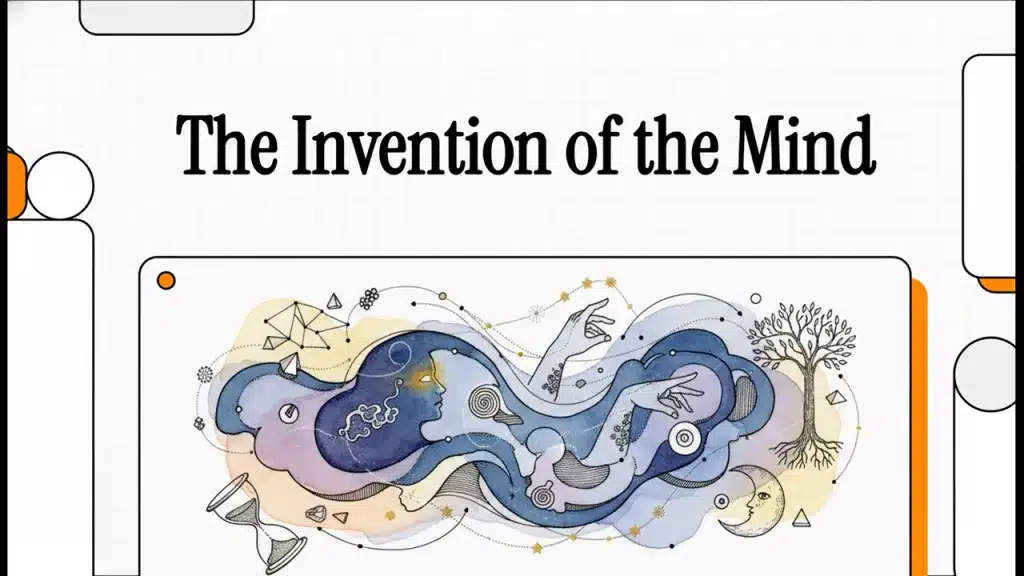
The Invention of the Mind
Julian Jaynes’s Ideas on Consciousness and the Self
Let’s start with a question that sounds, well, it sounds super simple: “Where do our dreams come from?” I mean, for us, right now, the answer feels totally obvious — almost instinctual. Our dreams, are feelings — all that stuff — it comes from that private universe inside our own heads. This quote from the Romantic era just nails it. Our inner life, that personal passion, it’s not just a part of who we are, it feels like the whole point of our existence.
Our Private Universe: The Modern Inner World
So, let’s start right there — let’s dive into this private universe we all seem to have — the modern inner world. We’re talking about that rich, complex, and, you know, deeply personal landscape that each of us is carrying around.
So when you and I think about a modern dream, there are certain things we just assume, right? We think it bubbles up from our subconscious, that it’s packed with symbols that are unique to our lives. We see a dream as a space for us to reflect on our fears and what we want. And, and this is a big one, it’s a form of self-narratization. We’re basically telling ourselves a story about ourselves, starring, well, ourselves. This whole intense focus on an inner autobiographical life, that really exploded back in the Romantic era.
An Ancient Dream Book: A Challenging Discovery
Okay, but what if I told you that this entire way of thinking, this whole idea of a personal symbolic dream, is actually a pretty new invention? Yeah. Let’s jump in a time machine, because an amazing discovery from the ancient world presents a completely, well, alien way of experiencing the mind.
So picture this, it’s the nineteenth century, and archaeologists are digging in the ruins of the library of the last great king of Assyria, and among thousands and thousands of clay tablets, they find this: the Zaqiqu. It’s one of the most complete dream manuals from the ancient world, basically a direct window into the minds of our ancestors, and what it showed them was frankly shocking.
Leo Oppenheim, one of the top scholars who translated this thing, came to this absolutely stunning conclusion. Now, look at this quote really closely. The dreams these ancient people were recording, they weren’t symbolic puzzles you had to solve. They weren’t personal reflections at all. They were direct, literal messages from the gods. No interpretation needed.
Just think about that for a second. Imagine not having to wade through all this bizarre imagery to figure out what your subconscious is trying to tell you. Nope, you just dream that a god shows up and tells you to do something. The message was the dream. It was just an order.
And this table just lays out the massive gap between their mental world and ours. Look at this. For them, the source of a dream, external. It’s the gods. The purpose, a divine command. The meaning, one hundred percent literal. Now, look at us. The source is internal. It’s the self. The purpose is reflection, and the meaning is symbolic. It is like we are talking about two completely different operating systems for the human mind.
So this leads to a huge question, right? How is that even possible? Was their psychology just totally different from ours? Were they just, I don’t know, misinterpreting everything? Or was something way more radical going on with the very nature of human consciousness itself?
A Different Mind: A Controversial Theory
And that question brings us to a really mind-bending and pretty controversial theory that tries to explain this whole mystery. It suggests the answer isn’t just about different beliefs, but about a fundamentally different kind of mind.
Just think about this for a second. What if that inner voice you hear in your head right now, you know, the one that’s narrating your life, the one that feels like the essential you… What if that’s not a biological fact of being human? What if it’s something we learned?
Okay, so the fancy academic term for this is “conscious interiority.” I know, it sounds complicated, but it’s just describing something we all know intimately, that private mental space where we think, and we worry, and we tell ourselves stories. It’s that feeling that there is an ‘I’ inside looking out at the world.
And here is the absolute core of the theory from a psychologist named Julian Jaynes. He argued that this conscious interiority, this inner narrator, it isn’t something humans have always had. He said it’s a learned skill, a kind of cultural technology that only showed up around the time of the late Bronze Age collapse, maybe three thousand years ago.
So what was there before? Jaynes called it a “bicameral mind.” People back then, he said, didn’t have an inner dialogue. Instead, when they were in a stressful or new situation, that impulse to make a decision wouldn’t feel like their own thought. It would feel like an external command, almost like an auditory hallucination. And in the ancient world, what do you call a commanding, disembodied voice? You call it the voice of a god.
Divine Message to the Self: Connecting the Evidence
Okay, that’s a wild theory, I know. So let’s bring it back to the evidence we started with, those really, really different dreams. Does this theory actually explain what we’re seeing in the historical record?
Check out this perfect example from a cuneiform tablet. The Babylonian king Nabonidus has a dream. The gods Marduk and Sin literally appear and give him a direct order: rebuild the temple. Now, the fascinating part is, Nabonidus doesn’t try to interpret this. He takes it literally. He even argues back. He’s like, “But the Medes are surrounding the temple.” It’s a straight-up conversation, not a symbol. This is exactly what Jaynes’ theory would predict.
All right, now let’s fast-forward two and a half thousand years to the Romantic era. The focus could not be more different. Suddenly, you see the rise of the autobiography. Art becomes all about projecting your inner psychoscape, your moods and feelings, onto the world around you. The whole point of life, as one historian put it, became the feeling of feeling. The self was no longer a receiver of divine commands; it was this huge internal territory to be explored and narrated.
The Birth of ‘Me’: The Invented Self
So what does all this mean for us? If this theory is even close to right, it forces us to completely rethink what it means to be a conscious human being. This timeline kind of maps out the whole journey. Before about twelve hundred BCE, you’ve got this older mentality of just hearing divine voices. But Jaynes argued that as ancient societies got more complex and chaotic, especially during the Bronze Age collapse, that whole mental model just broke. You couldn’t just sit around and wait for a voice to tell you what to do. So humans were forced to develop a new cognitive tool, a portable internal narrator that could simulate different outcomes and help make complex decisions. That was the birth of our inner voice, and from there, it was refined over centuries, leading to the super introspective self of the Romantic era.
And this really brings us to the biggest takeaway of all: that constant chatter in your head, the very thing that feels the most like you, it might not be a biological inheritance. It could be a cultural one. Our consciousness has a history. It was invented, probably out of necessity, like a piece of mental software we developed to navigate an increasingly complex world.
And that leaves us with one last really provocative question: If our modern narrative self is an invention and it’s only a few thousand years old, it’s almost definitely not the final chapter in the story of the human mind.
So what do you think comes next?