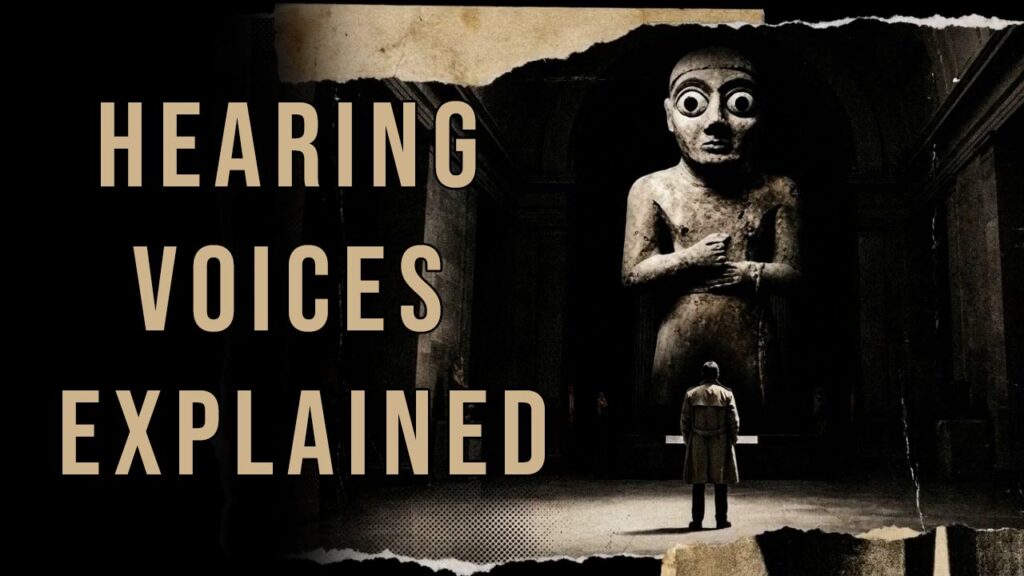
The Origin of Hearing Voices Explained: How Bicameral Mind Theory Explains Auditory Hallucinations
Modern psychiatry treats hearing voices as a rare, severe symptom of a broken mind, associating it almost exclusively with conditions like schizophrenia. In this framework, an unbidden voice is proof of a biological malfunction. However, today, hundreds of recent studies have documented auditory hallucinations across a wide spectrum of perfectly healthy populations. These are people with no history of mental illness, who nonetheless report hearing voices with the same clarity as an external speaker.
This chart contrasts our common assumptions with clinical reality. While we often assume healthy children never hear voices, researchers found that between 30 and 65% of children experience imaginary companions that involve genuine perceivable auditory hallucinations.
Even in populations that have never physically spoken, the phenomenon persists. When psychiatrist John Hamilton studied non-verbal quadriplegics, he found they regularly heard guiding voices. These weren’t chaotic distractions. They provided specific instruction and guidance during moments of isolation.
The fact that these reports remain consistent across children, students, and the physically disabled suggests that psychiatric labels have missed a common neurological baseline. Voice hearing is far more frequent than a rare disease model would allow. These hallucinations follow a specific logic. They are rarely random noise. Instead, they manifest as command hallucinations, voices that comment on behavior and issue instructions with the same hierarchical authority we associate with leaders or deities.
If human consciousness is roughly 100,000 years old, as the standard biological model suggests, there is no clear evolutionary reason for the brain to generate behavioral commands that sound like they belong to someone else.
In 1976, Princeton psychologist Julian James proposed a theory to address this specific contradiction. He argued that the origin of these voices wasn’t in medicine, but in the history of human organization. If Jaynes is right, these hallucinations provide the physical link between the structure of the human brain and the sudden emergence of ancient civilization. Jaynes’s thesis, the bicameral mind, suggests that human consciousness is not biological. He argued it was a cultural invention, a set of habits learned roughly 3,000 years ago through the development of complex metaphorical language.
Before 100 B.CE, Jaynes argues that humans lacked internal introspection. When faced with a novel situation or a moment of high stress, the right hemisphere of the brain would process the problem and formulate a solution unconsciously. That solution was then transmitted to the left hemisphere where the person perceived it as a literal auditory hallucination. They didn’t think of an answer. They heard a commanding voice they interpreted as a dead king or a god.
We see this in the earliest Greek texts. The characters in the Iliad lack a vocabulary for internal reflection. They don’t weigh options or engage in self dialogue. They simply comply with the voices of gods who appear during crisis to issue orders. For thousands of years, humanity managed cities, irrigation, and war without consciousness. They operated through a network of shared hallucinations that preserved social order. This psychological structure physically built the ancient world.
In Mesopotamia, gods were not abstracts. They were the literal owners of the land. The massive ziggurats served as the physical infrastructure for a society governed by divine hallucinations. The idols recovered from these sites served as physical focal points, tools designed with unnaturally large staring eyes to stabilize the neural networks that produced the voices of authority.
Jaynes offered a specific neurological prediction. These voices originated in the language areas of the right temporal lobe and traveled across the corpus callosum, to be heard in the left hemisphere language centers.
In 1999, breakthrough imaging studies vindicated his model. Scientists found that during active hallucinations, the right temporal lobe language areas activate first, followed by the left, exactly as Jaynes had described decades earlier. Jaynes had mapped the neural geography of the ancient mind before the technology existed to confirm the location of active hallucinations.
This history reframes modern psychiatric conditions. Schizophrenia appears through this lens as a partial relapse into humanity’s earlier bicameral mentality. The command hallucinations reported in modern wards follow the original evolutionary logic of the right hemisphere. Its purpose was to direct behavior and ensure survival in the absence of a conscious self.
It also accounts for why children often hear voices today. In the ancient world, these hallucinations were encouraged until they became a personal god. Today, we spend years training our children to interiorize those voices into silent thoughts. Hypnosis, speaking in tongues, and the voices heard by poets are not glitches in the brain. They are surviving components of the system that built human civilization.
Today, groups like the Hearing Voices Network use this historical context to remove the stigma from their experiences. Understanding the history of the mind helps patients see their voices as part of a common human heritage rather than a sign of brokenness. This theory changes how we view ancient texts, the physical ruins of the past, and the very nature of human thought.
To explore the evidence from the scientists working on this theory today, you should read Conversations on Consciousness and the Bicameral Mind. You can find more research at julianjaynes.org, linked in the description below. We are used to looking inward to find ourselves. But we cannot fully understand our current minds until we recognize the ancient voices we once followed.