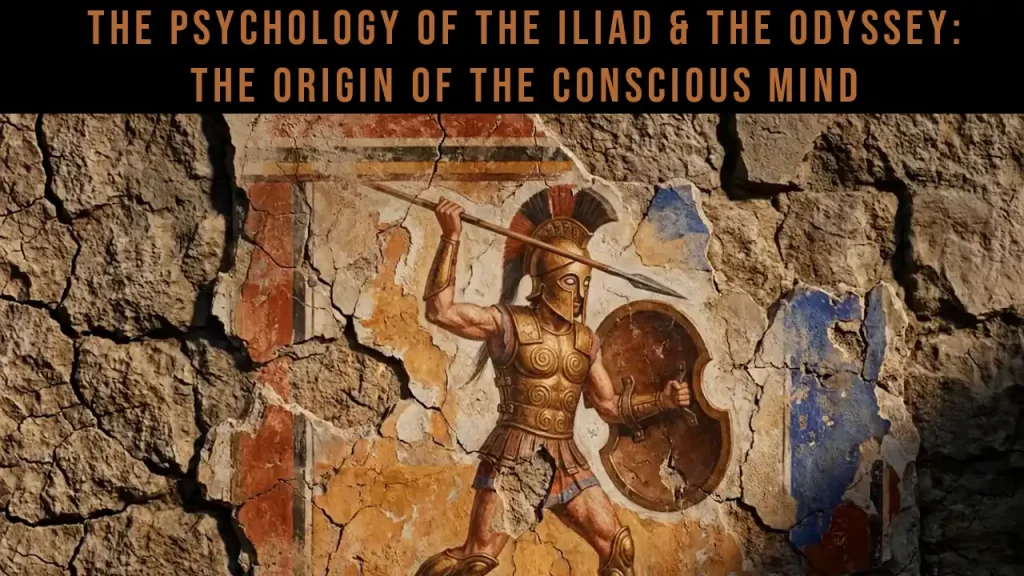
The Psychology of the Iliad and the Odyssey
The Origin of the Conscious Mind
When we think about the people who fought the Trojan War, we naturally assume they possessed an inner monologue. We imagine them feeling fear, weighing their tactical options, and making conscious choices. But the textual evidence suggests the warriors of 1200 BCE had no internal mind at all.
Look at this ancient depiction of Achilles. In the Iliad, Achilles never stops to deliberate. When he faces a crisis, he doesn’t pause to weigh the consequences. Instead, he experiences sudden, overwhelming auditory and visual hallucinations, literal voices of gods that command his next strike.
Now, contrast that with this image of Odysseus on a ship from the Odyssey. He is a hero from just a few centuries later. Yet he relies on plotting, deceit, and intense introspection. He even has to physically tie himself to a mast to battle his own psychological urges.
Here is psychologist Julian Jaynes. In the 1970s, he proposed that the severe contrast between these two epics is a literal, historical record of the human mind transitioning from bicameral mentality to consciousness. Reading Homer allows us to examine the fossil record for the birth of subjective consciousness.
This is the Lion Gate at Mycenae. It stands as physical proof that early humans built massive cities, maintained complex trade routes, and fielded fast armies, all while entirely lacking self-awareness.
In this schematic, we see Jaynes’s bicameral mind. In ancient humans, the right hemisphere processed complex decisions. Without an internal ego, that data was transmitted to the left hemisphere, experienced as an external commanding voice.
Archaic texts like this one offer proof. Scholar Bruno Snell found the Iliad contains zero vocabulary for mind or soul. The words later used for those concepts started out biological. Thumos described physical energy, and psyche simply the breath leaving a dying person’s lungs. By the time of the Odyssey, the definition morphed into a metaphor for an internal mental state used to describe “feeling” or “thought.”
This chart shows the frequency of physical action words versus internal mental words. Statistical research reveals a sharp increase in mental language between the Iliad and the Odyssey.
Because they lacked an inner life, they also lacked guilt. Historian E. R. Dodds noted that when a hero like Agamemnon made a terrible mistake, he didn’t feel internal remorse. He projected the error outward, blaming his actions on “ate,” a divine delusion forced into his head from the outside.
This is a Linear B tablet from the Mycenaean era. To keep society from collapsing into chaos when everyone is following hallucinated voices, civilizations relied on rigid theocratic hierarchies. Rulers received commands from the gods, and scribes recorded strict inventories of goods and debts owed to divine authorities. These were highly intelligent, communicative humans. They built empires by operating as automatons executing the mandates of the voices in their heads.
Around 1200 BCE, the Bronze Age collapsed. Earthquakes, mass migrations, and the spread of writing introduced an immense amount of cognitive stress. The societal hierarchies fractured, and the voices of the gods became confusing, contradictory, or went completely silent.
The Odyssey chronicles the aftermath of this collapse. In this later epic, gods are notably weaker. They begin to hesitate, they endlessly argue, they rely on magic wands and physical human disguises. Stripped of divine guidance in a highly unpredictable world, humanity had to adapt to survive. Odysseus represents this adaptation. He survives by deceiving the people around him.
This animation illustrates the mechanics of a lie. To deceive someone, a person must hold a truth internally while presenting a false action externally. This requires the invention of an entirely new psychological architecture, a private inner world or “mind-space,” separate from physical reality.
With a mind space established, humans could retain memories of their own past actions. The external public shame of the Bronze Age evolved into private internal guilt. People gained the capacity to reminisce, evaluate their past, and feel regret. A secret creates a private sanctuary where a hallucinated voice cannot reach.
Once we could hide our thoughts from the gods, their absolute control was broken, marking the birth of the modern self. This psychological shift allowed for a completely new way of perceiving human existence.
Classical historian Chester Starr pointed out that the bicameral humans of the Iliad had no concept of the past or the future. They existed in a mythic continuous present, unable to see how one human action caused another over a long period.
Look at how this single point expands. The creation of a conscious mind-space allowed humans to spatialize time. They could mentally travel backward along this line with regret and project forward with anxiety. This temporal awareness awakened the historical spirit. The Greeks began to record their past as a continuous series of factual events driven by human choices and politics, rather than supernatural interventions.
By inventing history, humanity declared its independence. We became the authors of our own fate. The Odyssey is a blueprint of humanity navigating the terrifying and lonely landscape of consciousness.
To explore the specific mechanics of this psychological evolution, Conversations on Consciousness and the Bicameral Mind breaks down the evidence across neuroscience, ancient history, and modern psychology. You’ll rethink ancient history, the biology of your thoughts, and the origin of your mind. You can find a link to the book in the description below.