The Software of the Mind: Unlocking Consciousness and Bicameral Mentality
Right now, a voice in your head is narrating these words. We tend to assume this internal monologue is an innate piece of biological hardware, something that evolved right alongside our lungs and our heartbeat. But your mind has a few strange glitches.
Think about the experience of being lost in the sound of a complex melody, or how a sudden strike of poetic inspiration feels less like thinking and more like transcribing a message from somewhere else.
Then consider the strange paradox of hypnosis. How can a person successfully quit smoking via an external suggestion when their conscious inner voice failed for years? These aren’t random quirks.
According to the research in Conversations on Consciousness and the Bicameral Mind, these phenomena point to a radical shift in how we understand the human experience. These thinkers propose a concept called “consciousness as software.”
The theory argues your ability to introspect is not a biological certainty. It is a piece of cultural technology invented roughly 3,000 years ago. If our inner lives are a learned operating system rather than a fixed biological law, then understanding where that code came from is the first step in deciphering why we think the way we do.
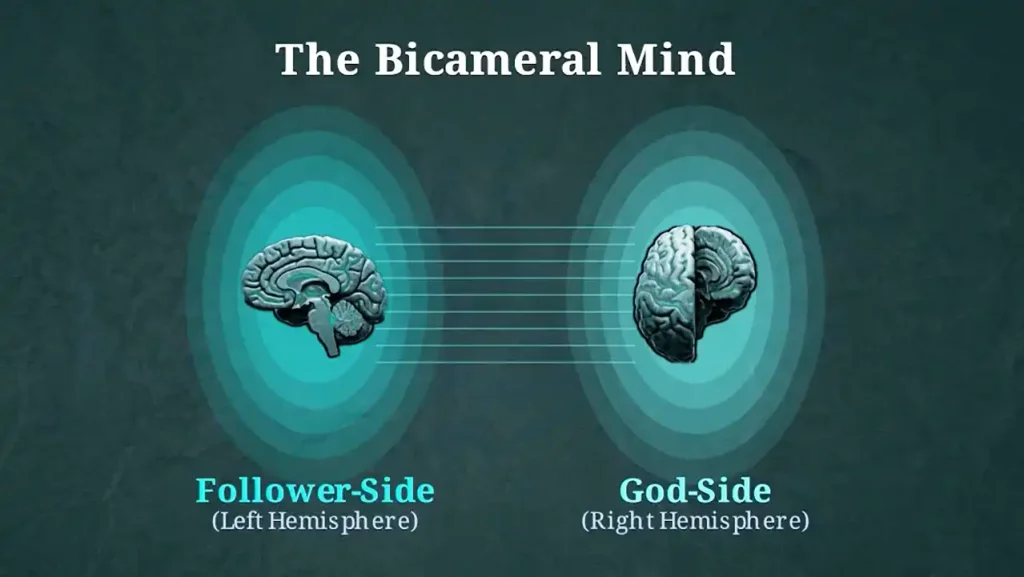
To understand this, we have to look at the world before that software was installed. Three thousand years ago, humans were building massive, complex civilizations, yet the evidence suggests they possessed no internal thoughts or self-awareness as we know it. Instead of consciousness, they operated on the bicameral mind, a two-chambered mental system where the brain was split between a god side and a follower side.
This was a neurological mechanism for social control. In times of stress or conflict, the brain’s right hemisphere generated strict auditory commands to guide behavior. The left hemisphere heard these commands, but because there was no inner ‘I’ to claim the thought, the person interpreted the voice as an external authority — a literal god, a king, or a dead ancestor dictating their every move.
This system worked for millennia until the world became too complex for it to handle. The catalyst for the breakdown was what you see here — writing. As laws were carved into permanent clay, the need for hallucinated auditory commands vanished. The once booming voices of the gods began to retreat into a terrifying silence. This silence triggered a structural failure in human society. Without the voices to maintain order, ancient hierarchies crumbled into chaos. To survive this social collapse, our ancestors had to find an entirely new way to organize their reality.
The response was the invention of subjective consciousness. Humans began using complex language to bridge the gap left by the silent gods. We developed a metaphorical mind-space. By using physical words to describe the mind, like “seeing” a solution or “grasping” a concept, we constructed an imaginary inner theater. Within this theater, we created an analog ‘I’ that could narrate potential futures and deliberate choices, allowing us to make decisions without an external command.
But the old bicameral system didn’t disappear. It went dormant, leaving neurological echoes that still drive our behavior today. This is why music and poetry feels so profound. They activate the right hemisphere — the ancient god side. When an artist feels inspired, they are often tapping into the same neural pathways that once organized divine hallucinations.
Hypnosis is another clear remnant. As seen in these women, the state perfectly bypasses our modern software, revealing an ancient predisposition to surrender our agency to an external authorizing voice. These glitches in our minds are actually the breathing ruins of our ancestors, operating just beneath the surface of our modern awareness.
Think of the anxieties and pressures you feel every day. Most of that noise comes from the way we narrate our own lives. We still search for what’s called “archaic authorization.” Our modern obsession with gurus, influencers, or rigid political ideologies is a direct holdover from our ancient need for a god voice to tell us how to act. When you realize your inner voice is a learned cultural metaphor, you can finally detach from it. Your thoughts are not absolute truths. They are just the output of your current software.
This perspective allows you to step back and edit your reactions. You can consciously reprogram your internal narrative, rather than simply reacting to it. The expert discussions and Conversations on Consciousness and the Bicameral Mind serve as a roadmap for this process, providing the context needed to achieve this level of meta awareness.
It is time to stop being a passive passenger to your ancient programming. Use the link below to get the book and take control of your mental environment. By examining the history of our hallucinating ancestors, we stop being victims of the past and begin to understand the true architecture of the human mind.