Consciousness and Dreams
Summary: “Consciousness and Dreams” by Marcel Kuijsten delves into Julian Jaynes’s theory regarding the relationship between dreams and the development of consciousness. Jaynes posits that in ancient times, humans experienced dreams as external voices or commands from gods, a phenomenon he associates with the “bicameral mind” — a mental state preceding modern consciousness. In this state, individuals lacked introspection and were guided by these auditory hallucinations.
As societies evolved, the reliance on these dream-induced directives diminished, giving way to introspective consciousness. Jaynes suggests that the transformation of dream experiences played a pivotal role in this shift. By analyzing the structure and content of dreams, he argues that they reflect the transition from a bicameral mentality to conscious thought. This perspective offers a unique lens through which to understand the evolution of human consciousness.
In The Origin of Consciousness in the Breakdown of the Bicameral Mind, Julian Jaynes discusses a variety of forms of evidence for the transition from a bicameral mentality to consciousness. The study of dreams provides another window through which to examine this transition. By extension, historical changes in the nature of dreams support the idea that consciousness is in a learned process based on language and not biologically innate.
Conscious vs. Bicameral Dreams
There is a common assumption that the nature of dreams has been consistent throughout recorded history, yet this is not the case. If we analyze the first recorded accounts of dreams and compare these accounts with modern dreams, we see a stark contrast.
In modern conscious dreams, we see ourselves acting out events in other places and from various perspectives. According to Jaynes, conscious dreams are both vicarial and translocative. Vicarial means that in your dream you are doing something other than lying in your bed sleeping — you have an analog ‘I’ that can move around and do things. For example, if you imagine yourself playing tennis, that is vicarial, as you are not really playing tennis. Translocative means that in your dream you are in another location. If in your dream you are anywhere other than in your bed, that is translocative. Contemporary dreams are both vicarial and translocative, and, according to Jaynes, that requires consciousness. Thus dreaming is the operation of consciousness during sleep.
By contrast, the earliest recorded dreams are not vicarial or translocative. They are bicameral dreams that typically consist of the dreamer having the feeling of being asleep in bed and then being visited by a god or spirit who issues a warning or command.
Descriptions of dreams in the ancient world can be found in E.R. Dodds’s The Greeks and the Irrational (1951). Dodds notes that:
Most of the dreams recorded in Assyrian, Hittite, and ancient Egyptian literature are ‘divine dreams’ in which a god appears and delivers a plain message to the sleeper, sometimes predicting the future, sometimes demanding cult.
Oxford University classicist Charles Stewart (2005) notes that dreams in the Iliad were “generally conceived as a personified force that travelled from the realm of the gods to the beds of humans.” Historian William Harris (2009) describes how many dreams in antiquity were “described as what we can call epiphanies: an authority figure visited the sleeper and made a significant pronouncement, and that was the [entire] dream.” In contrast to epiphanies, he describes modern dreams as “episodes.”
An example of a bicameral dream is Agamemnon’s dream in the beginning of Book II of the Iliad. In this dream Agamemnon is visited by Onieros, who appears in his dream as Nestor (one of the generals of the army) and tells him to start the Trojan War.

This is not an isolated example — the ancient literature “is full of these ‘godsent’ dreams in which a single dream-figure presents itself, as in Homer, to the sleeper, and gives him prophecy, advice, or warning” (Dodds, 1951).
Classicist William Messer (1918), describing Agamemnon’s dream, comments:
…Note the entire externality, the complete objectivity, of the dream. The dream is an entity. There is no statement that Agamemnon dreamed that Nestor appeared, or that he beheld him in sleep. … In all its acts, then, the dream is objective and personal. It is … portrayed as an external entity, with power of moving, thinking, and speaking, like to any herald sent by the gods, a genuine dream daimon.
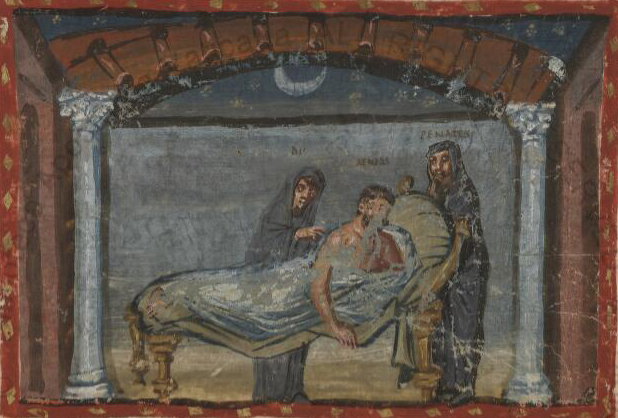
Another example, reminiscent of Homer, can be found in Vergil’s Aeneid, where Hector, dead and covered in wounds inflicted by Achilles, appears to Aeneas in a dream and urges him to take the “household gods” or idols (penates in Latin) and flee Troy (Kyriakou, 1999). Later, the penates appear to Aeneas in a dream and call on him to leave Crete and go to Italy. Those familiar with Jaynes’s theory will note the similarity of these dreams to the waking auditory hallucinations — often elicited by idols —commonly experienced at this time. These scenes were later illustrated in the Vatican Vergil, one of the oldest illustrated manuscript books known, created in Rome and dating to around the fifth century (Wright, 1993).
During the early conscious period in Greece (from roughly 1200–200 BCE), dreams slowly begin to be attributed to internal states rather than direct commands from the gods; however they continue to be seen as a source of prophecy. And while Aristotle (384–322 BCE) was skeptical of this and articulated a modern view of dreams in his On Prophecy in Sleep, “the general population continued to hold that dreams could be interpreted to forecast the future” (Stewart, 2005).
During this period of slow transition from bicamerality to consciousness — which also saw the emergence of omens, oracles, prayer, and divination — the Greek diviner Artemidorus “differentiated so-called ‘state dreams’ (enypnia) — produced by current worries, feelings, or wishes — from prophetic dreams (oneiroi) that could literally or allegorically tell the future” (Stewart 2005).
Dreams in Preliterate Societies
In Primitive Mentality (1923), Lucien Lévy-Bruhl describes the same type of bicameral dream in pre-literate cultures worldwide. Like the dream reports from ancient civilizations, the dreams of pre-modern peoples are nonvicarial, non-translocative, and are either of a prophetic nature or involve the conveyance of direct orders. For example
The Azande of the Upper Congo believe that during the night the dead make their wishes known to the living. Dreams are quite authentic to them, and they are convinced that when they see a dead relative in a dream they really have a conversation with his ghost, and in its course he gives advice, expresses satisfaction or displeasure, and states his aspirations and desires.
The Iroquois … have, strictly speaking, but one divinity, which is the dream; they submit to it and follow all its orders most implicitly.’ … It is not simply a question of advice, hints, friendly suggestions, official warnings conveyed by dreams; it is nearly always definite orders, and nothing can prevent the Indian from obeying them.
Dreams in Children
The study of dreams in ancient civilizations and pre-literate societies demonstrate that dreams can be used as an indication of the level of consciousness in a given culture. Similarly, children’s dreams provide evidence that dreams can be used as an indication of the level of consciousness in a developing child. In Children’s Dreaming and the Development of Consciousness (2002), child psychologist and dream expert David Foulkes challenges the popular misconception that dreaming is “a given” in human experience. In a section on the development of consciousness in children that sounds surprisingly reminiscent of Jaynes, Foulkes writes: “I hypothesize that dreaming is simply the operation of consciousness in sleep … that consciousness develops, and that it does so more slowly and later than is generally believed” (Foulkes, 2002).
According to Foulkes, the nature and content of children’s dreams changes dramatically over time. For example, during the preschool years, “dreams are brief and infrequent; they focus on body states; their imagery is static.” Dreams slowly transform to those experienced in adulthood between the ages of 5 and 9:
First, dream reports become longer, but not more frequent, and now describe social interaction and the kind of movement that suggests kinematic rather than static imaging; still lacking, however, is active participation in dream events by the dreamer herself or himself. Next, dream reports become more frequent as well as longer and narratively more complex, and active self-participation becomes a general possibility, along with, for the first time, the reliable attribution to the self of feelings and thoughts occurring in the dream in response to dream events (Foulkes, 2002).
The dreamer does not regularly appear as an active participant in his or her dreams — according to Jaynes, one of the hallmarks of conscious dreams — until between the ages of 7 and 9. Conscious dreams, therefore, seem to be infrequent until some time after the child has developed consciousness in waking life.
The content of dreams provide another method to gauge the level of consciousness in a given culture or individual. If language had no effect on consciousness — or if consciousness developed far back in our evolutionary past and has remained unchanged since — we would expect dreams to remain unchanged both throughout recorded history and throughout an individual’s development. Instead, dreams reflect developmental stages in mentality from pre-conscious to conscious, brought about by changes both culturally as well as in the linguistic sophistication of the dreamer.
Dreams in bicameral cultures lack consciousness — an analog ‘I’ narratizing in a mind-space, and mimic the waking experience of receiving behavioral commands from gods. In contrast, the dreams of conscious individuals reflect conscious narratization during sleep.
References
Dodd, E.R., The Greeks and the Irrational (University of California Press, 1951/2004).
Foulkes, David, Children’s Dreaming and the Development of Consciousness (Harvard University Press, 2002).
Harris, William V., Dreams and Experience in Classical Antiquity (Harvard University Press, 2009).
Kyriakou, Poulheria, “Aeneas’ Dream of Hector,” Hermes, 1999, 127 (3): 317–327.
Lévy-Bruhl, Lucien, Primitive Mentality (Nabu Press, 1923).
Messer, William Stuart, The Dream in Homer and Greek Tragedy (Columbia University Press, 1918).
Stewart, Charles, “Dreams,” in N.G. Wilson (ed.) Encyclopedia of Ancient Greece (Routledge, 2005).
Wright, David H., The Vatican Vergil: A Masterpiece of Late Antique Art (University of California Press, 1993).
The essay originally appeared in The Jaynesian, Winter 2010, Volume 4, Issue 1.