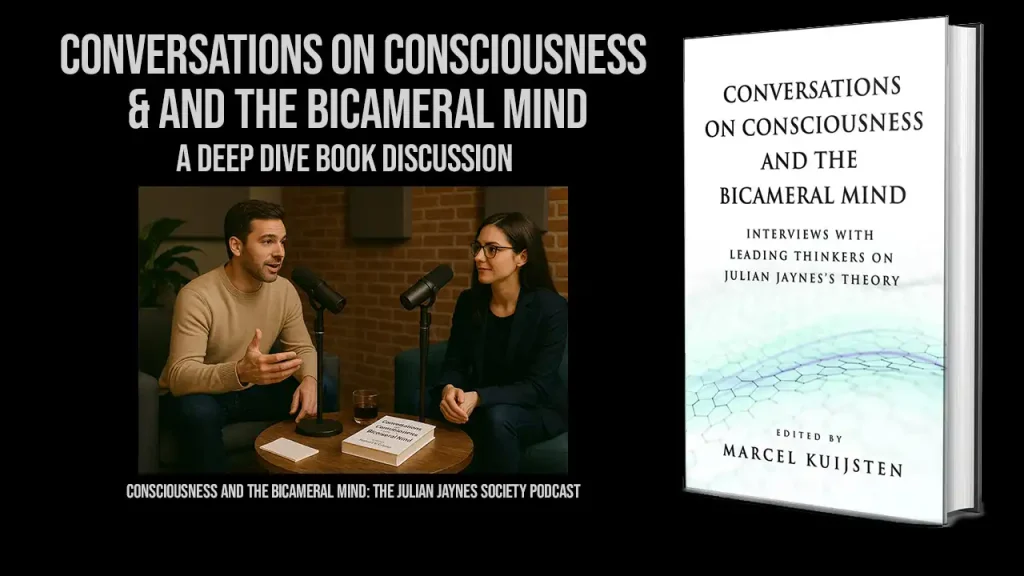
Conversations on Consciousness and the Bicameral Mind: A Deep Dive Book Discussion
Welcome to Consciousness and the Bicameral Mind, the Julian Jaynes Society Podcast.
Learn more about Julian Jaynes’ theory or become a member by visiting the Julian Jaynes Society at www.julianjaynes.org
A deep dive discussion on the book Conversations on Consciousness and the Bicameral Mind: Interviews with Leading Thinkers on Julian Jaynes’s Theory. Edited by Marcel Kuijsten.
Have you ever had that feeling that you’re talking to yourself inside your head? Not out loud, but that internal voice, that running commentary.
Oh, absolutely. Or, you know, when a brilliant solution or maybe a creative idea just pops into your mind.
Exactly. Like seemingly out of nowhere, fully formed.
Yeah. Or sometimes people feel a kind of presence or guidance even when they know they’re alone.
These are such common things, aren’t they? But also, when you think about it, deeply puzzling parts of being human. And, well, they might just be echoes. Echoes connecting us back to a really groundbreaking and, let’s be honest, often misunderstood theory about where consciousness actually came from.
Which brings us to today’s deep dive.
Right. Today, we are diving deep into the fascinating world of Julian Jaynes’s theory of the bicameral mind.
But we’re coming at it through a really unique and, I think, incredibly insightful lens.
Yeah, this book, Conversations on Consciousness and the Bicameral Mind.
And the great thing is this is not your typical academic book, you know, filled with dense, dry prose.
Not at all. It’s actually a collection of these really captivating interviews. You get leading experts, scholars, even people whose lives and work just naturally intersect with Jaynes’s ideas.
And they cover pretty much every conceivable angle of this theory, which is pretty complex stuff.
It really is. And the book uses this interview format, which is just, well, it’s a refreshing way to grapple with concepts that can feel a bit abstract or, you know, difficult sometimes.
Exactly. Framing it through dialogue, you get all these diverse perspectives. You hear about current research findings, historical context. It kind of feels like you’re eavesdropping on a really great conversation.
Totally. So our mission here in this deep dive is basically to be your guides. We want to pull out some of the most compelling insights, those “aha” moments from these conversations in the book.
Yeah, give you a real sort of in-depth taste of the book’s remarkable breadth and depth. We want to try and make Jaynes’s theory feel a bit more accessible, maybe reveal some of his lesser known sides.
And ultimately show you why this book, this collection of perspectives is genuinely a must-read if you’re curious about the mind, about history, psychology.
Or fundamentally, what it even means to be conscious.
Right. And it’s probably worth saying upfront, know, groundbreaking theories. Think about Darwin or germ theory.
Yeah, they often face pushback?
Exactly. Initial resistance, misunderstanding, just because they challenge how we normally think. And Jaynes’s work is definitely in that category.
Oh, absolutely. It proposes such a radically different view of human history, of our psychology, that it can be tough to wrap your head around at first. Or maybe even accept.
And that’s one of the real strengths of this book, Conversations on Consciousness. It really helps clarify a lot of those points, tackles the common misconceptions head on.
It lets you see the theory through the eyes of people who are actively researching and thinking about it now.
OK, so where do we start? Maybe with the biggest hurdle?
I think we have to. The word consciousness itself, it’s used so broadly, isn’t it? In everyday chat, even across different academic fields, it gets incredibly confusing.
Yeah, it’s often vague. Sometimes it has this almost mystical, spiritual vibe around it?
Which is worlds away from how Jaynes uses the term. He’s much more specific.
He really is. know, people use consciousness for everything from just being awake, aware of your surroundings.
To having deep self-awareness, reflecting on your thoughts and feelings.
Yeah, exactly. And Marcel Kuijsten, one of the key voices in the book, he has this great analogy.
Oh, yeah.
He says, using consciousness like that is like calling all fruits and vegetables just produce.
Ha. OK, I like that.
Right. It’s technically true. But it just collapses all the really important distinctions, you know, between an apple, a potato, a banana — you lose all the nuance.
And that’s exactly what happens with consciousness as a catchall. You lose the crucial details.
So Jaynes demands precision here.
Total precision. His core definition, and this is laid out in his original work, but discussed all through this book by people like Kuijsten and Jan Sleutels, and others. His definition is very, very specific. He defines consciousness as an analog ‘I’, narratizing in a functional mind-space, which is introspectable.
Okay, whoa. Let’s definitely break that down. That’s a mouthful. Each part sounds important.
It really is. Every piece matters.
Yeah.
So the analog ‘I’ — that refers to that felt sense of having a self, right? A central character, an agent inside your head.
The “me” that’s thinking and deciding.
Exactly. The ‘I’ that thinks, decides, remembers, plans. But Jaynes argues this isn’t the whole you. It’s a constructed model, like an analogy of your physical self operating internally.
Like an avatar in an inner world.
That’s a great way to put it. Yeah, like an inner avatar.
OK, so that’s the analog ‘I’. What about narratizing?
Narratizing is what that analog ‘I’ does. It’s the running commentary, the internal monologue, the constant storytelling we do in our head.
Making sense of things.
Yeah, constructing narratives about our past, our present, figuring out the future. It’s how we make sense of the world and our place in it.
Okay, and this happens in a functional mind-space.
Right, the functional mind space. This is that metaphorical inner world, the stage, the landscape where the analog ‘I’ operates and tells its stories.
So when we say things like, “inside my head,” or “keep it in the back of your mind.”
Exactly, or “a heavy heart,” “feeling down” — we’re using metaphors drawn from the physical world to structure and understand this internal space. It’s where we mentally hold and manipulate ideas, replay scenarios, access memories.
Okay, analog ‘I’, narratizing, mind-space. And the last part, introspectable.
Introspectable simply means we can look into this mind-space. We can examine the thoughts and feelings happening there, reflect on them. It’s what we normally think of as introspection, observing our own internal mental processes.
So for Jaynes’s, that whole complex package, the analog ‘I’ telling stories in a mind space you can look into — that’s consciousness.
Precisely. It’s not just being aware or having feelings or solving problems. Those can happen without this specific kind of consciousness.
Which leads to another absolutely critical point he makes, right? The difference between this specific consciousness and, well, almost everything else our mind does?
The vast, vast majority of mental activity that is non-conscious. This distinction is fundamental to getting Jaynes. And it’s something people like Kuijsten, Brian McVeigh, Lauren Sugarman really emphasize in the book.
So non-conscious is everything else?
Pretty much. Sensing the world, seeing, hearing, touch, learning, memory formation, complex problem solving, motor skills like riding a bike, emotional responses, instincts, reflexes.
All animal behavior.
Yes, exactly. Animals are incredibly sophisticated mentally. They navigate complex environments, learn tasks, solve problems, have social interactions — all without that inner, narratizing analog ‘I’.
And honestly, the same is true for so much of what we do, even really complex stuff.
Think about driving a car, especially when you’re experienced, or playing a musical instrument you know well, or even just having a sudden strong emotional reaction to something.
Yeah, a lot of that is happening automatically, non-consciously. Lawrence Sugarman, in the book, talks a lot about this non-conscious learning, how much of our behavior is driven by things outside our conscious awareness.
It is. Our conscious mind, in this specific Jaynesian sense, is really just the tip of the iceberg.
But it doesn’t feel that way, does it? Our everyday experience feels like consciousness is running the whole show. Like it’s this constant light guiding every thought, every action.
Right. And Marcel Kuijsten points out that this feeling is part of the illusion that consciousness creates. It’s narratizing, it’s telling the story, and it often takes credit for things that are actually happening non-consciously. Which brings us to maybe the most counterintuitive part of Jaynes’s theory, something the book really digs into.
That consciousness, as he defines it, is learned.
Learned. Not something we’re just born with. Not something that evolved biologically super early on.
Nope. He argues it’s a cultural and linguistic construction. Something that emerged relatively recently in human history.
Wow. Okay. That’s probably the toughest pill to swallow initially, isn’t it? Because conscious experience feels so fundamental, so hardwired.
It absolutely does. But the book, through people like Kuijsten, Bill Rowe, Eduardo Casiglia, John Kihlstrom, it lays out the argument that this particular kind of mentality, this introspectable mind-space, actually requires certain cultural and linguistic building blocks to develop.
Okay, prerequisites. Let’s get into those. What needs to be in place for this learned consciousness to even start developing?
Language. That’s presented as the absolute foundation, the bedrock, the necessary precondition. It’s not just helpful, but necessary. According to the theory, yes. Kuijsten, Rowe, Casiglia, Kihlstrom — they all stress this. Without complex symbolic language, the kind that allows for abstraction and metaphor, you just can’t build that internal metaphorical mind space. You can’t create the analog ‘I’.
So language lets us categorize, symbolize, manipulate ideas mentally.
Exactly. In the specific ways required for this Jaynesian consciousness, it’s the toolkit.
And the book brings up some pretty compelling, though often sad, evidence for this link between language and this kind of mind.
Yes, the case studies of children who are raised with extreme language deprivation, they’re often cited as supporting evidence.
Like Helen Keller before she learned language, or Kaspar Hauser.
Precisely. Joseph, the deaf boy, Oliver Sacks wrote about. As Kuijsten notes in the book, accounts suggest their mental lives were profoundly different before they acquired language. They seemed largely confined to the immediate present.
No complex planning for the future or detailed reflection on the past.
Not in the way that people with language and consciousness seem to do it. Lacking that capacity for abstract thought. Now, obviously more research is always needed. These are complex cases.
Sure.
But they’re incredibly suggestive about how much our minds, or at least certain capacities of our minds, depend on language.
It really drives home that language isn’t just for talking to others. It’s fundamental for building our own internal world, our sense of self.
Exactly. And it’s not just about having language in a vacuum. It’s deeply tied up with our social development.
How so?
Bill Rowe really emphasizes this in his interview. He talks about consciousness as a constructivist process, meaning it’s built, it’s learned through social interaction.
So a child needs a certain kind of social environment. Yes, a context that sort of demands cognitive flexibility, communication, navigating complex relationships, things that push you towards abstract thought and making choices.
This sounds like it connects to theory of mind development in kids.
It absolutely does. Bill Rowe and John Kihlstrom both discuss this connection in the book. Theory of mind, know, the ability kids develop usually solid around age four or five, pretty much universal by six or seven.
To understand that other people have minds, beliefs, desires, intentions that are different from their own.
Exactly. You learn to interpret and predict what other people will do based on these invisible mental states. You’re learning to read other people’s internal worlds. And then, Bill Rowe points out this remarkable shift, often around age seven or so. Children start applying that same interpretive toolkit to themselves.
Ah, they turn it inward.
Precisely. They start seeing themselves as an object with internal states, thoughts, feelings, beliefs that they can examine and reflect on, just like they learn to do with others. That’s a huge step towards developing that introspectable analog ‘I’.
You basically learn to read yourself, using the tools you developed for reading others. That’s fascinating.
It’s a really powerful idea, isn’t it? Our self-awareness, our ability to introspect, might be built on the very cognitive machinery we evolved or developed for understanding the people around us.
So our inner life is fundamentally social in its origins.
That’s the argument. And Bill Rowe even suggests, kind of intriguingly, that studying autism, which involves significant challenges in social interaction and communication, could actually shed unique light on how consciousness develops, precisely because of this social constructivist angle.
If social interaction is the crucible where the conscious self is forged, then looking at conditions where that interaction is different could tell us a lot.
Potentially, yes.
It’s an avenue for research suggested in the book.
OK, so if this conscious mentality is learned, relatively recent, built on language and social interaction, when did this massive shift happen? When did we transition from whatever came before to this? That brings us to Jaynes’s third hypothesis, right?
Yes, exactly. Jaynes’s third hypothesis specifically tries to date the transition.
Yeah.
The shift from what he called bicameral mentality, that earlier state where people experienced auditory hallucinations, the voices of gods guiding their actions.
To our modern subjective consciousness.
Right. And he places this transition mainly between roughly 1500 and 1200 BCE.
That specific.
That’s the core period he identifies in key regions like ancient Egypt. Greece, Mesopotamia, ancient Israel. But as Marcel Kuijsten points out in the book, the evidence suggests it might have happened later elsewhere.
Like the Americas or Easter Island?
Possibly, yes. It wasn’t likely a single global event, but more of a rolling process, happening at different times in different cultures as the necessary conditions arose.
OK, so how does Jaynes possibly arrive at that dating? What’s the evidence? It seems incredibly bold to pinpoint something like that.
It is bold, and he uses several lines of evidence discussed in the book, but a primary one is linguistic analysis. He meticulously traces how the language used to describe mental states evolves in ancient texts.
Looking at how words change meaning over time.
Exactly. The introduction and Dedović’s interview really dive into this. A classic example James uses is the ancient Greek word noos.
Noos?
Initially, in the older texts, noos seems to refer to physical body parts, maybe the lungs or the midriff, or sometimes just direct visual perception, like a sudden seeing of something.
That’s concrete stuff.
Very concrete. But then, over centuries, the meaning of noos shifts. It evolves to mean something much closer to what we would call “conscious mind” or “understanding” or “intellect.”
So Jaynes is saying the language changed because the psychology changed?
That’s the core argument. It wasn’t just people deciding to use an old word for a new idea. The word’s meaning tracked a fundamental shift in human experience itself.
And Dedović’s work, which is discussed in the book, provides really interesting contemporary support for this approach.
He looks beyond Greek.
Yes, he examines mental language in ancient Greek texts like the Iliad and Odyssey, but also in Middle Egyptian texts. He even introduces this concept of “pre-conscious hypostases.”
Pre-conscious hypostases?
Yeah, basically placeholder terms in ancient languages, for archaic mental concepts that just don’t map neatly onto our modern ideas of “belief” or “intention” or “desire.”
So trying to translate them directly using our modern concepts would be misleading.
Hugely misleading. Dedović really emphasizes the danger of “presentism,” mistakenly projecting our own modern psychology, our own conscious framework, back onto ancient peoples when we read their texts. We assume they experienced the world just like us, just with different words, but Jaynes and Dedović argue their fundamental experience might have been different.
This linguistic evidence seems tightly linked to Jaynes’s famous analysis of literature, doesn’t it? Especially comparing the Iliad and the Odyssey.
Oh, absolutely central. And Kuijsten, Dedović and Rabbi James Cohn all touch on this in their interviews. Jaynes does this incredibly detailed close reading.
The Iliad comes first, generally considered older material.
Right. And in the Iliad, the characters, while they seem largely driven by external commands, things they perceive as coming directly from the gods, their actions are often reactions to these perceived voices or divine signs.
Not much internal debate or planning.
Very little, as we understand introspection today. Achilles might be furious, ready to draw his sword, and then Athena appears, or is perceived to appear right there, tells him not to strike Agamemnon, and he just obeys. The motivation feels external, immediate.
Okay, contrast that with the Odyssey, later text, different vibe.
Completely different psychological vibe. Odysseus, the hero. He is constantly planning, scheming, deceiving, worrying internally, reflecting on his past mistakes, anticipating future problems.
Lots of internal monologue.
Tons of it. There are long passages depicting his inner turmoil, his strategic thinking. Jaynes argues this stark difference in the portrayed inner lives isn’t just a stylistic choice. It reflects that historical shift.
From bicameral mentality, guided by external voices.
To subjective consciousness, where individuals deliberate internally develop plans based on introspective thoughts and feelings.
And this shift in psychology must have changed how people related to their gods too.
Profoundly. Kuijsten discusses this transformation. In the bicameral world, the gods weren’t distant concepts. They were perceived as vividly present, speaking directly, almost like a coach yelling instructions from the sidelines.
Immediate guidance.
Exactly. But then as the bicameral mind started to break down, maybe due to social stresses, writing, whatever the complex causes were, those internal guiding voices started to fade. They grew less frequent, less reliable, more distant.
The gods retreated.
The perceived gods retreated, yes. They became figures residing on mountaintops or in the heavens, not right there in your head or beside you. And this loss of immediate divine guidance, Jaynes argued, created a kind of societal crisis.
People were left without that direct instruction.
Which led to the development of all sorts of new behaviors aimed at trying to regain contact, or at least get some direction from the now distant gods. Things like consulting oracles, reading omens in sheep livers or bird flight, various forms of divination, the rise of prophesy where specific individuals claim to still hear divine messages, and the formalization of prayer where humans started talking to gods who weren’t necessarily talking directly back in the same way anymore.
Wow. So these religious practices could be seen as adaptations to the loss of the bicameral mind?
That’s the Jaynesian interpretation, yes. The response to the silence.
OK, so if this bicameral mentality was the dominant way humans experienced the world for thousands, maybe tens of thousands of years, are there still traces of it left? Echoes or vestiges, as Jaynes called them, in modern life?
This is one of the most fascinating and I think for many people, really surprising parts of the theory. And the book dedicates a lot of space to exploring these potential modern vestiges.
And a huge one is the experience of hearing voices, right?
Auditory hallucinations. Absolutely. Which, as you know, in our modern Western culture, is almost automatically linked to severe mental illness, primarily schizophrenia.
Yeah, it’s seen as a clear symptom of pathology.
Exactly. And the book, particularly through Kuijsten’s discussion, really challenges that narrow and actually quite recent view.
[inaudible]
Relatively speaking, yes.
Kuijsten points out that for most of human history, many cultures, hearing voices wasn’t necessarily seen as illness. It was often interpreted as spiritual contact, divine inspiration, communication with spirits, ancestors, demons.
So the illness model is newer.
The idea that hearing voices is solely a symptom of brain disease really only gained traction in the late 1700s and became dominant in the 19th and 20th centuries with modern psychiatry.
And the book highlights modern research showing it’s actually way more common than we think.
Hugely more common. This is a major focus in the interviews with people like Stanford anthropologist Tanya Luhrmann and also the pioneering Dutch clinicians Marius Romme, Sandra Escher, and Dirk Corstens.
They work directly with voice hearers.
Yes, for decades. Their work moves beyond just seeing voices as pathology. The research cited in the book suggests that depending on how you ask the question, somewhere between five percent and maybe even up to 80 % of the general population report hearing a voice at some point when alone without having a diagnosed mental illness.
Five to 80%. That’s an enormous range, but even the low end is significant.
It’s a huge range. Yeah, methodology matters, but it strongly suggests voice hearing isn’t restricted to clinical populations. Romme, Escher, and Corstens have validated these experiences and developed ways to help people cope and live meaningful lives with their voices, not just suppress them.
And the book talks about the different ways people experience these voices. It’s not uniform.
Not at all. They can be inside the head, outside, loud, soft, male, female, friendly, critical, single voice, multiple voices.
Dirk Corstens even mentions some people describing it like reading subtitles. The voice is just there, integrated into their awareness in a particular way.
And there’s a focus on linking voices to life experiences too, not just brain chemistry.
Yes. The book explores models like the one Corsten’s discusses, linking the onset of distressing voices to overwhelming emotional experiences, trauma or major life stressors. It provides a psychological context. Michel Knowles shares his own powerful story in the book about a critical trainer voice emerging during a time of deep insecurity and how we eventually learn to understand and integrate it.
Corstens also mentions that voices can speak metaphorically.
Right. That a command like you must kill yourself might not be literal. It could be a metaphorical expression of needing profound change — kill your old life, start a new one. Understanding that potential symbolic meaning can be transformative for the hearer.
Tanya Luhmann’s research adds a really important cross-cultural layer to all this.
Her interview is fantastic. She’s done ethnographic fieldwork, studying voice hearing in places like India, Ghana, and the U.S. And she found really striking differences. Like how? For example, the nature of command hallucinations often differed. In her samples from India and Ghana, voices were more often described as less harsh, sometimes playful or offering guidance. Whereas in the U.S. sample, voices were more frequently reported as violent, hostile, commanding self-harm or harm to others.
Wow. So culture shapes the experience of the voice?
It strongly suggests that, Which reinforces the idea that it’s not just a uniform biological glitch. Culture, belief systems, social context — they all seem to play a huge role. She also studied voice hearing among homeless people and looked at evangelicals who actively cultivate hearing God’s voice or sensing an imagined other.
So voices appear in many different contexts, not just clinics.
Exactly. Her work really bolsters the Jayesian idea that maybe voice hearing is a kind of basic human capacity, something our brains can do, and how it manifests is then shaped by personal history, culture, and context.
This idea of an imagined other or a sensed presence seems really close to the bicameral concept, too.
It does. Luhmann explores that connection, know, childhood imaginary friends, and that feeling adults sometimes get, especially under stress or in isolation, that someone else is there, just out of sight.
The sensed presence phenomenon.
Luhmann wonders if we’ve maybe drawn too sharp a line between these things. She suggests the mind might be more fundamentally social, perhaps with a built-in capacity for generating a sense of an other.
Like the evangelical Christians she studied, actively trying to sense God’s presence or hear his voice.
Exactly, cultivating that sensed presence. And Elizabeth Bell Carroll talks about her own experiences, including sensed presences during moments of extreme danger or isolation. She connects it to research like John Geiger’s book, The Third Man Factor, about these guiding incorporeal presences people report in survival situations. And Peter Suedfeld’s work too. She found Jaynes offered a powerful framework for making sense of her own visions and what felt like external intelligence communicating with her.
It makes these experiences seem less alien, maybe?
Exactly. It normalizes them to some extent, frames them historically and psychologically.
OK, so voice hearing is a major vestige. What else? The book talks about hypnosis, right?
Yes, definitely. This comes up in the interviews with Kuijsten and Laurence Sugarman, Eduardo Casiglia, and John Kihlstrom. Jaynes saw hypnosis as a really clear relic of bicameral functioning.
How so?
In hypnosis, the hypnotist essentially takes on the role of that external guiding voice, the authority figure. They give instructions, suggestions, commands.
And the hypnotized person follows them, often bypassing their usual conscious deliberation or willpower.
Exactly. The power seems to lie with the hypnotist’s voice. Much like Jaynes proposed, the power lay with the perceived voices of the gods in bicameral times. It’s like a temporary voluntary return to that state of external guidance.
This seems to connect with Lawrence Sugarman’s ideas about non-conscious learning and authorization that you mentioned earlier.
It really does. Sugarman, being both a physician and a psychologist, talks powerfully about how much we run on autopilot — non-consciously. He makes this great distinction between external authorization —
Needing permission or direction from outside, like from parents, doctors, bosses.
Right. Or even getting a diagnosis can feel like external authorization. He contrasts that with internal authorization — cultivating our own mental skills, self-regulation, tapping into our own inner resources.
His idea of replacing “pills with skills.”
Exactly. Empowering people to use their own non-conscious capacities and strengths, which feels like the opposite trajectory of the bicameral mind developing internal resources, instead of relying solely on external commands.
But the book also has this interesting debate about whether hypnosis is really external or if it’s all self-hypnosis in the end.
Yeah, John Kihlstrom, who’s a major hypnosis researcher, leans towards the self-hypnosis view. He argues the power is ultimately with the subject’s ability to enter that state and accept suggestions. Highly hypnotizable people can even do it just from reading a script.
So the hypnotist is more like a facilitator. That’s one perspective. Sugarman, while he talks about leaving hypnosis behind — with a question mark — importantly seems more focused on moving beyond the maybe unnecessary rituals and external focus of traditional hypnosis towards building those internal skills, but maybe not dismissing the psychological effect of perceived external authority entirely.
Kuijsten adds a wrinkle too, right? Saying even using a recording for self-hypnosis still feels like external authority.
Yeah, he points out that nuance. Even if it’s your own voice on tape, the source feels external in that moment. So it’s a really rich discussion in the book about where the agency and authorization truly lie in hypnosis. It’s not simple.
Okay, another vestige. What about creative inspiration? That feeling some artists or writers talk about like they’re channeling something?
Yes, Kuijsten discusses this, especially in poetry. He brings up examples like William Blake.
Blake claimed his poems were dictated to him.
By external sources, yeah — angels, spirits — he felt he was almost just transcribing. That’s very different from the feeling of consciously deliberately crafting a poem word by word.
It sounds much more like the bicameral experience receiving a message from an external authoritative source.
Exactly. It points to those powerful, non-conscious creative processes that can sometimes surface in a way that feels like external input, like a vestige of that older way of operating.
And the whole evolution of religion itself seems like a huge cultural example of this shift Jaynes describes.
Absolutely massive. It’s central to Jaynes argument and gets a lot of attention in the book. Kuijsten contrasts ancient religion, which Jaynes saw as immediate, active, gods perceived as present speaking, giving commands like that coach on the sidelines.
[Compared] with modern religion.
Right. Where the divine is often conceptualized as distant in heaven, and believers seek guidance indirectly through interpreting sacred texts, listening to sermons, or through their own internal conscious reflection and prayer. It’s a different relationship.
And Brian McVeigh, in his interview, offers a specifically Jaynesian reading of the Bible. He does, and it’s fascinating. He looks at things like prophecy not as direct dictation anymore, but as a later, more mediated form of communication that emerged as the immediate voices faded.
What about idolatry?
He suggests idolatry might not just be about worshiping statues. Maybe for a consciousness struggling to regain contact with the loft voices, idols served as potential triggers, focal points to try and induce visual or auditory hallucinations, a kind of technology.
Interesting. And angels, ritual purity?
He sees angels emerging as intermediaries, messengers needed once God’s direct voice wasn’t constantly heard. And things like complex ritual purity laws could be seen as providing external structure and rules for behavior when constant divine micromanagement was no longer perceived.
A way to maintain order without the voices.
Potentially. And he discusses the whole transition from the Old Testament to the New, including the role of figures like Jesus, providing a different kind of charismatic human-level guidance, and a new framework for relating to the divine after the bicameral structure had largely dissolved.
The book also mentions things like spirit possession, shamanism.
Briefly, yeah. Kuijsten suggest these might involve altered states, maybe shifts in brain hemisphere activity that could be reminiscent of bicameral states. McVeigh shares his own surprise, actually, finding spirit possession quite prevalent in modern Japan and noting that conventional psychology doesn’t really have a good framework to explain it, which again suggests maybe we need a broader historical lens like Jaynes’s.
Even ancient cave art gets a mention.
It’s touched upon by Kuijsten and McVeigh, but the idea is that maybe those incredibly vivid paleolithic paintings aren’t necessarily signs of modern abstract thought or complex language, but could reflect something like eidetic imagery. Like photographic memory, hallucinatory vividness.
Exactly. Suggesting possibly a different kind of ancient mentality, one more dominated by intense visual recall and perhaps hallucinatory perception than by abstract symbolic thought.
It feels like all these different vestiges — voice hearing, hypnosis, inspiration, religious practices, maybe even possession, they all seem to point back to some kind of fundamental human tendency or maybe a leftover capacity to seek or generate external guidance?
That’s a really key takeaway from this section of the book. Kuijsten explicitly connects them. He suggests we see echoes of this longing for the lost bicameral authority all over modern life.
In organized religion, obviously, but where else?
He suggests maybe in the appeal of cults, the intense following of celebrities, even the way people sometimes look for definitive answers or validation from doctors or diagnostic labels. It’s as if the breakdown of the bicameral mind left a kind of vacuum, a need for external authorization that our conscious, deliberating mind still sometimes struggles to fill completely on its own.
OK, let’s circle back to language for a minute, because the book really hammers home how central it is not just for communication, but as the actual builder of our inner world, our mind-space.
Absolutely. This is such a profound Jaynesian insight. And it’s elaborated on really well by Kuijsten, Ted Remington, Casiglia, Kihlstrom in their interviews. Metaphorical language is the architect.
How does that work?
We take concepts in the physical world, the world we can see, touch, move through, interact with, and we apply them metaphorically to describe our internal subjective experience. That’s how the mind-space gets built.
Ted Remington explains Jaynes’s specific way of breaking down metaphor. It’s quite technical.
He does. Remington uses Jaynes’s example, “the snow blankets the ground.” Blankets is the metaphier.
The word borrowed from its literal meaning.
Right. The term taken from the physical world, “blanket on a bed,” and used figuratively. The metaphrand is the thing being described — in this case, the snow covering the ground.
And the metaphor transfers properties.
Exactly.
Features of the metaphier, like covering — maybe softness, warmth — get transferred onto the metaphrand. Remington notes this is similar to I.A. Richard’s concepts of vehicle and tenor, but Jaynes’s real focus is on how this mechanism allows us to build abstract concepts and that entire internal landscape.
And this isn’t just for simple physical descriptions, it applies to big abstract ideas, too.
Absolutely critical point. Remington highlights this. Think about concepts like “law,” “freedom,” “virtue,” “justice.” These are fundamentally metaphors built up from analogies to physical or social experiences.
But we treat them like they’re real things.
We do. We talk about them, argue about them, structure our lives around them as if they have a tangible reality, a presence in our mental world, much like we treat our analog ‘I’ as if it’s a single solid real entity. This metaphorical construction process is foundational to consciousness.
Which leads to another really mind-bending Jaynesian idea mentioned in the book about hallucination being a kind of collapse.
Yeah, Ted Remington presents this intriguing thought. In bicameral times, the voices of the gods were perceived as external — real. Jaynes suggests that maybe modern hallucinations in this framework represent a temporary breakdown of that learned boundary between the internal, metaphorical mind space and external reality.
So the internal stuff gets mistakenly projected outward.
Right. The internal constructs — thoughts, voices, images — are misperceived as having actual physical existence outside the body. The metaphor collapses back into perceived reality.
And Dedović’s linguistic research, tracing how mental words changed in ancient Greek and Egyptian, that seems to provide real concrete evidence for this metaphorical building process over time.
It really does. His work, discussed in his interview, is so compelling because it’s not just theorizing. He’s painstakingly showing how terms originally tied to physical actions or locations gradually shift their meaning to describe internal states.
He talks about the “container metaphor of mind,” too.
Yes. How we constantly use language derived from physical containers and spatial relationships to talk about our minds. “What’s on your mind?” “Get it out of your head.” “Keep that in the back of your mind.” “A mind full of ideas.”
We treat the mind like a physical space you can put things in or take things out of.
Exactly. And this linguistic pattern, Dedović argues, clearly demonstrates how we use metaphors grounded in our physical interaction with the world to construct, understand, and communicate about our internal mental world. It’s strong support for Jaynes’s argument about consciousness being metaphorically constructed.
Okay, this is all fascinating psychologically and historically, but what about the physical brain? Does modern neuroscience offer any support, or does it contradict Jaynes?
This is another area where the book Conversations, provides really crucial up-to-date insights, especially in the interview with Iris Sommer, but also discussed by Kuijsten and others.
Did Jaynes himself make any predictions about the brain?
He did, remarkably. Decades before modern brain imaging, Jaynes proposed a specific neurological mechanism for how he thought the auditory verbal hallucinations of the bicameral mind might have worked.
What was his prediction?
He hypothesized that the voices were generated in the language areas of the non-dominant hemisphere, usually the right hemisphere for most people.
Okay, generated in the right.
And then perceived or heard by the language areas in the dominant hemisphere, usually the left via, the corpus callosum.
That big bundle of nerves connecting the two halves.
Exactly. So he predicted a specific kind of cross-hemisphere communication involving language areas during these hallucinatory experiences. That’s incredibly specific for the time. So
What does modern brain imaging show? it line up?
This is where it gets really interesting. Iris Sommer, who is a leading psychiatrist and researcher using fMRI and other techniques to study hallucinations. She discusses this in her interview.
fMRI measures brain activity through blood flow changes?
Right. And starting around the late 90s, early 2000s, researchers began using fMRI to look at the brains of people while they were actively experiencing auditory verbal hallucinations.
And what did they find? Did it match Jaynes’s prediction?
What’s striking is that multiple studies from different labs using slightly different methods started converging on a similar pattern. They consistently found activation and interaction between language related areas in both the right and left temporal lobes during hallucinations.
Both hemispheres involved?
Yes. Activity in areas typically associated with language production, often more left dominant, areas involved in language comprehension, also largely left, but with right hemisphere input for things like emotional tone. And crucially, evidence of communication between these areas often involving the right temporal language regions interacting with the left.
So interaction between right and left language areas during hallucinations, that sounds pretty close to what Jaynes predicted.
It aligns remarkably well, as Marcel Kuijsten emphasizes in the book. It’s not a perfect one-to-one match in every single study. The brain is incredibly complex, research is ongoing, but the overall pattern of evidence showing bilateral language area involvement and interaction during hallucinations provide significant empirical support for a key neurological aspect of Jaynes’s model.
That’s pretty amazing considering when he proposed it.
It really is. It suggests his psychological model had some neurobiological grounding.
Iris Sommer also mentioned split brain studies briefly. How do they relate?
Yeah, those are the studies, often originally on patients who had their corpus callosum severed to treat severe epilepsy — they revealed just how independently the two hemispheres can sometimes operate.
Like one hand literally not knowing what the other is doing because the hemispheres can’t communicate directly.
Exactly. Sommer notes that while it’s complex, the findings from split brain research showing these two potentially independent spheres of cognition offer some intriguing, though not direct, parallels to Jaynes’s idea of different mental functions. Perhaps operating more separately before the integration that consciousness represents.
Now, John Kihlstrom, in his interview, raises an important philosophical point, doesn’t he, about whether psychology even needs neurology to be valid?
He does, and it’s a fair point. Kihlstrom argues, essentially, that psychology is a valid level of analysis in its own right. You can describe and theorize about psychological phenomena like memory, learning, hypnosis, consciousness, without necessarily needing a complete neurological explanation for them to be real or for the theory to be useful.
The mind isn’t just the brain.
Right. But the counter argument, which Kuijsten makes and you see reflected elsewhere in the book, is that while a neurological explanation might not be strictly necessary for a psychological theory to be valid, when you do find neurological evidence that aligns with the theory’s predictions —
Like the fMRI studies of hallucinations.
Exactly. It significantly strengthens the theory. It provides powerful corroboration and suggests the psychological model is likely capturing something real about how the brain functions.
Kihlstrom also talks about brain plasticity, right? The brain’s ability to change.
Yes. He correctly points out that brain plasticity is the mechanism by which individuals learn and develop new capacities, including potentially learning consciousness. But crucially, he notes that individual plasticity doesn’t explain the cultural transmission of consciousness across generations.
So just because my brain learns something doesn’t mean my kids inherit it biologically?
Right. It’s not Lamarckian inheritance. This actually supports Jaynes’s argument that consciousness spread culturally, linguistically, like a learned skill or a powerful set of ideas — a meme essentially — rather than being genetically hardwired and passed down biologically. The brain provides the capacity, but culture provides the content and the training.
Okay, so let’s free and pull all these threads together. We’ve gone through Jane’s definition, the prerequisites, the dating, the vestiges, the role of language, the brain evidence. What are the big takeaways? What does this deep dive into Conversations on Consciousness and the Bicameral Mind really mean for us today?
Well, I think one of the biggest shifts is perspective, especially around experiences like hearing voices. If you start to see it not just as a symptom of illness, not just brain pathology —
But potentially as tapping into a basic human may be a remnant of an older mentality shaped by culture and experience.
Exactly. It completely changes how we approach understanding those experiences, how we might support people who have them, and it changes how we view human history and the sheer diversity of human minds across time and cultures.
Are there implications for modern psychology or therapy discussed in the book?
Definitely. Brian McVeigh talks about this. He connects Jaynesian ideas to things that make psychotherapy work, like helping people build a coherent sense of self, fostering self-reflection, developing internal coping mechanisms.
His FOCI concept, features of conscious interiority.
Right. It’s a framework he developed, inspired by Jaynes, to analyze the structure and function of the conscious mind and how it relates to mental well-being, resilience, the mind’s own self-healing abilities. You can see resonances with things like cognitive behavioral therapy, CBT.
Which is all about examining and modifying your own thoughts.
Precisely. Or practices like meditation, which are about cultivating conscious awareness of internal states. Understanding the structure of consciousness, as Jaynes described it, might inform how we help people strengthen it.
The book also reminds us about folk psychology, right? How our basic understanding of minds isn’t universal.
Yes. Jan Sleutels makes this point very clearly. Our everyday understanding of concepts like “belief,” “desire,” “memory,” “intention” — our folk psychology — is heavily shaped by our specific language and culture.
So we can’t just assume people in ancient Sumeria or Homeric Greece had the same folk psychology as us?
Exactly. Recognizing that cultural variability really underscores the difficulty and the danger of presentism when trying to interpret the minds of the past. Their whole conceptual toolkit might have been different.
And the idea that our very sense of ‘I’, our self-awareness, isn’t some innate essence but is learned, constructed relatively recently — that’s pretty mind-altering in itself.
It really is.
Casiglia, Rowe, Kilhstrom all emphasize this aspect, the conscious self, as a cultural and linguistic achievement. I love Casiglia’s poetic summary in the book: “We are conscious because we became our own voices.”
Internalizing that external guidance, transforming it into our inner monologue.
Yeah, that feels like a really neat encapsulation. The book even nudges into huge philosophical territory, like free will.
It does touch on it. Casiglia and Sugarman both note how Jaynes’s theory, by highlighting non-conscious processes and past reliance on external commands, naturally raises questions about free will. If our conscious ‘I’ is often just the narrator rationalizing decisions made elsewhere —
How much genuine independent conscious choice is there?
It certainly prompts you to think about where our decisions actually originate. It complicates the simple picture of a fully autonomous conscious self calling all the shots.
And John Kihlstrom offers that slightly different take on when consciousness really arrived.
Yeah, his idea of “consciousness of consciousness” — maybe some basic awareness was always there biologically, but the huge cultural leap was the realization that we have our own private thoughts and feelings distinct from others. Like the child finally grasping theory of mind, but on a cultural scale, realizing “I have a mind.” Exactly. He draws that parallel. And he points out that even today, research shows cultural differences in how and when kids fully develop theory of mind, which supports the idea that this kind of self-realization is culturally scaffolded, not just automatic biological unfolding.
Listening to all this, it makes you wonder where consciousness is heading now. Are we still evolving mentally?
That’s a really provocative question raised by Marcel Kuijsten in the book. He voices this concern about our increasing reliance on technology.
Technology doing our thinking for us.
In a way, yeah. Calculators doing math, spell checkers fixing writing, GPS handling navigation, algorithms making recommendations, or even decisions. Tasks that used to require more conscious effort, attention, skill.
And his worry is that we might lose those skills, like the bards losing their incredible memories after writing took over.
That’s the analogy he uses. If we constantly outsource cognitive tasks, do our own conscious muscles atrophy? Do we risk diminishing our capacity for deep critical thinking, for complex self-reflection, for integrating different kinds of knowledge and insight, especially maybe insights from both brain hemispheres?
So it’s a call to actively use and cultivate our conscious abilities, not just let them fade.
I think so. A call to engage in critical thinking, wrestle with complex problems ourselves, practice self-reflection, maybe engage in activities that require integrating different ways of knowing different parts of our minds? It’s a really important question for our time.
Are we in danger of letting our conscious abilities slide? It’s a powerful thought.
It really is. And maybe it’s the sheer depth and the provocative nature of all these ideas about history, the self, the future, that explains why Jaynes’s theory, despite being complex, has had such a surprising afterlife in popular culture.
Yeah, inspiring fiction, science fiction. Kuijsten mentions the HBO series Westworld even engaging with these ideas about consciousness and inner voices.
It clearly taps into something deep.
Well this has been a seriously deep dive hasn’t it? And honestly it feels like we’ve only managed to scratch the surface of what’s actually in this book, Conversations on Consciousness and the Bicameral Mind.
Absolutely. We’ve covered a lot the definition of consciousness, the learned nature argument, the historical evidence, the fascinating modern vestiges, the role of language, the brain science.
But the book goes into so much more detail on each of these. And it brings in those cutting edge perspectives we mentioned, like Tanya Luhrmann’s cross-cultural work on voices, really challenging a simple illness model.
Or, Iris Sommer presenting the brain imaging evidence that aligns so intriguingly with Jaynes’s predictions about hallucinations. Having those contemporary researchers involved is huge.
Hearing directly from them. And from others who actually knew Jaynes, like Brian McVeigh, or people who’ve spent their careers exploring these ideas. It gives the book such a unique energy. It’s not just a summary about the theory, it really is a collection of living insights from people deep inside it.
Which is exactly why we wanted to do this deep dive to strongly encourage you, the listener, to pick up Conversations on Consciousness and the Bicameral Mind and read it for yourself.
And don’t be intimidated by the topic.
Yeah.
Despite the complexity, the book is incredibly readable and engaging — that that Q & A format makes a huge difference.
Yeah, it really does feel like you’re just listening in on these amazing conversations. Jan Sleutels — Sleutels — even mentioned finding Jaynes’s original work accessible as a student, and this book makes the ideas even more approachable by bringing in all these modern voices and current research. It’s definitely not a dry textbook.
Not at all. And the sheer breadth is incredible. As we saw, it covers so many facets of Jane’s theory, including lots of the less discussed stuff, the detailed linguistics, vestiges like poetry or idols, different kinds of voices, the brain studies, therapy links, philosophical nuances.
It really does give you a much richer, more textured understanding of the whole theory and why it matters, how it can change the way you think about history, psychology.
And maybe even how you perceive your own mind, your own internal experience day to day. It genuinely opens up new ways of looking at things that might have seemed puzzling before.
We’ve tried to give you enough detail today to hopefully get you really interested, lay some groundwork, but honestly, there’s just so much more depth, so many more fascinating arguments and connections waiting for you inside the book itself.
The different perspectives from the interviewees add layers that we just can’t fully capture in a summary. You really need to read their own words.
So if anything, we’ve talked about today, the origin of consciousness, the history of the mind, those surprising echoes of the past in our modern world. If any of that sparked your curiosity…
Definitely consider grabbing a copy of Conversations on Consciousness and the Bicameral Mind. Continue this deep dog on your own terms. You won’t regret it.
Okay, so as we wrap up, maybe one last thought to leave you with. Something to chew on.
Go for it.
Given everything we’ve discussed, how much of our mental life might be non-conscious? How our self might be this learned, linguistic construct built over millennia? How much of what we experience as us, as our own conscious doing is truly independent conscious doing?
And, may be connected to that…
Yeah.
If technology keeps doing more of our thinking for us and we risk letting certain cognitive skills atrophy, as Kuijsten worried, what could that mean for the actual future of consciousness itself? Where is it heading?
Definitely something to ponder.
We really hope this deep dive has given you some valuable insights, some things to think about, and maybe inspired you to explore Julian Jaynes’s fascinating ideas further through this excellent book.
Thank you so much for joining us on this journey into the bicameral mind.
Until next time.